 English
 Français
 Deutsch
 Español
 Italiano
 Русский
 Português
 العربية
 Türkçe
 Magyar
 Svenska
 Nederlands
 Ελληνικά
 Български
 Polski
 Gaeilge
 Dansk
 Lietuvių kalba
 Suomi
 Hrvatski
 Română
 Latviešu valoda
 Korean

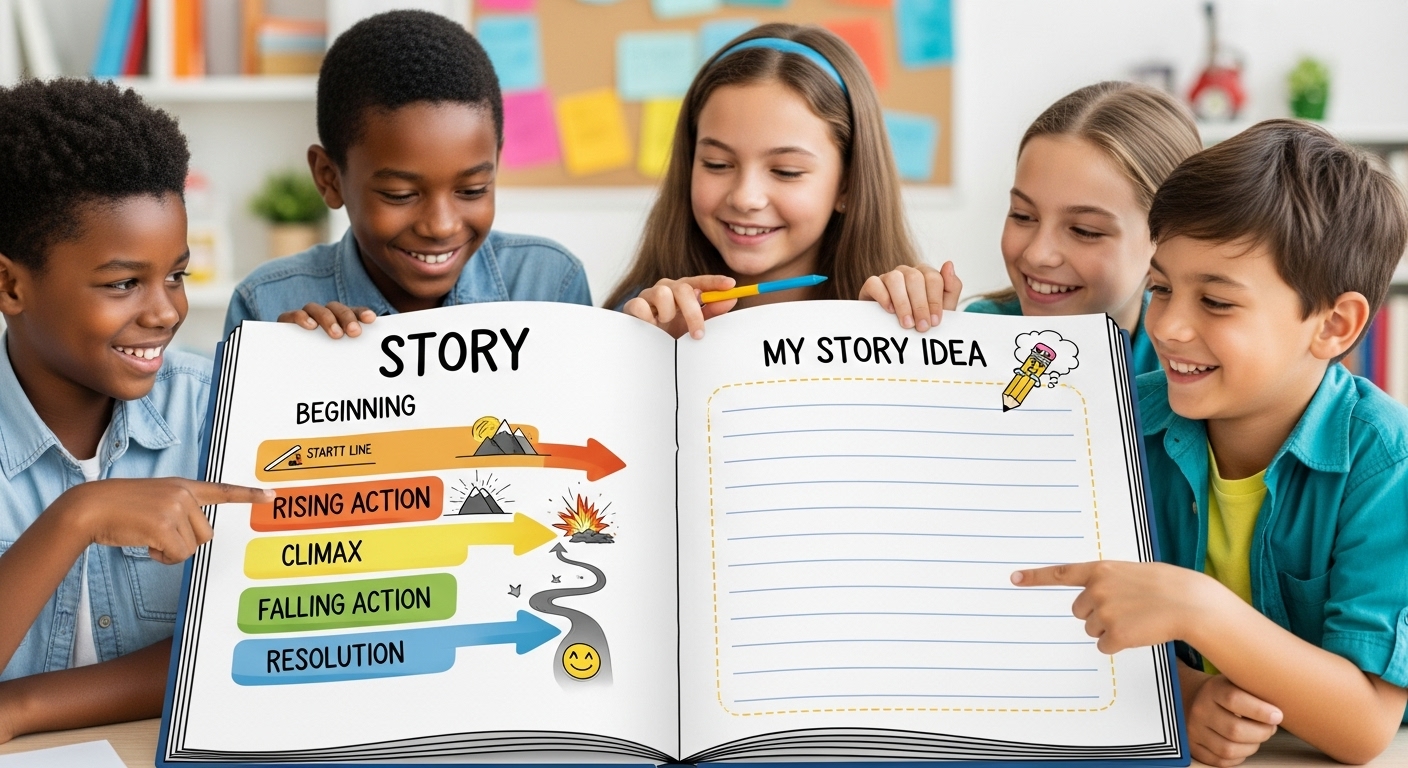
By grade 4, most children can write a story with a beginning, a middle and an end. The next step is learning to write a good one, and the quickest way there is to make the story smaller. Instead of “my summer holiday”, a grade 4 writer picks one moment that lasted a few minutes, such as dropping an ice cream or waiting for a test result, and stretches it out with detail. Many US teachers call this a “small moment” story. This guide shows how to choose the moment, add senses and feelings, link the parts with transition words and check the draft before it is handed in. If your child is still learning basic story order, start with our grade 3 four-step method.
Why small moments make better stories
Ask a nine-year-old to write about a whole day and you usually get a list: we went to the beach, we ate lunch, we went home. Each event gets one sentence, so nothing feels real. When the whole story is one moment, the writer has room to show what happened second by second, and the reader can see it, hear it and feel the nerves. That matches what the Common Core grade 4 writing standards ask for: narratives built with concrete words, sensory details, dialogue and a clear sequence of events.
A quick test: if the moment took longer than an hour, it is probably too big. Shrink it.
- Too big: my trip to Grandma’s house. Small moment: the second Grandma’s dog jumped on me at the door.
- Too big: my birthday. Small moment: blowing out the candles when one would not go out.
- Too big: soccer season. Small moment: the penalty kick in the last game.
Step 1: Find the moment with a heart map
Children often say they have nothing to write about. A heart map fixes that in ten minutes. Draw a large heart and fill it with small drawings or words: people they love, places they remember, times they were scared, proud, embarrassed or surprised. Then circle one item and ask, “What is one minute from that you remember really clearly?” That minute is the story.
Step 2: Plan it on five fingers
Before writing, have the child tell the moment across five fingers, one small action per finger. Saying it aloud shows straight away whether the story stays inside one moment.
- Where I was and what I was doing just before.
- The first thing that happened.
- What happened next (the most exciting part).
- What I did or said.
- How it ended and how I felt.
The middle finger is the heart of the story. That is the part to stretch the most.
Step 3: Stretch the middle with the senses
Most grade 4 drafts tell feelings (“I was nervous”) instead of showing them. Give writers a senses checklist for the most exciting part and ask them to add at least three of these:
- See: what colours, shapes or movements were there?
- Hear: what sounds, words or silence?
- Touch: was something cold, sticky, heavy or rough?
- Inside feelings: what did your body do? Shaky legs, a fast heartbeat, a lump in the throat.
- Smell or taste: only if it fits.
Compare “I was scared at the top of the slide” with “My fingers were sweaty on the cold metal rail. Below me the water slapped the sides of the pool, and I could hear my brother counting, one, two…” The second version never says “scared”, but the reader knows.
Step 4: Add one or two lines of talk
A little dialogue makes a moment come alive. Grade 4 writers do not need long conversations; one line that a real person said is enough. Teach three rules: start a new line when a new person speaks, put the spoken words inside quotation marks, and put the comma or full stop inside the closing mark. For example: “You can do it,” Mom called from the bench.
Step 5: Link the parts with better transitions
Grade 3 writers lean on first, next, then, last. Those words suit a story that covers a whole day. A moment that lasts only a few minutes needs closer time words:
- Just then, suddenly, all at once
- A second later, before I could move, at that moment
- While I waited, meanwhile
- Finally, in the end, after that
Ask the writer to underline every transition in the draft. If the same one appears three times, swap two of them.
Step 6: End with a thought, not “The end”
A strong ending tells the reader how the moment changed the writer or what they understood. Instead of “Then we went home. The end,” try “I still have the scratch on my knee, and every time I see it I remember that I didn’t give up.” An ending that grows out of the events is exactly what teachers look for when they mark the conclusion.
Sample small-moment story: The Last Spelling Word
Mrs. Patel held up the final card. The whole class went quiet. I was the last one standing at the front of the room, and my socks felt damp inside my sneakers.
“Your word is necessary,” she said.
My mind went blank. I could hear the clock ticking above the whiteboard and a chair creak in the back row. I closed my eyes and pictured the trick Dad had written on the fridge: a shirt has one collar and two sleeves. One C, two S’s.
“N-E-C-E-S-S-A-R-Y,” I said slowly.
For a second nobody moved. Then Mrs. Patel smiled, and the room exploded with clapping. My cheeks went hot, and I couldn’t stop grinning.
Now whenever a word looks hard, I look for a trick to remember it. A shirt on the fridge won me the spelling bee.
Why it works: the whole story lasts about a minute. It uses sound (the clock, the chair), touch (damp socks, hot cheeks), one line of dialogue from each person, and an ending that shows what the writer learned.
Common grade 4 mistakes
- The bed-to-bed story: starting when you woke up and ending when you went to sleep. Cut to the one moment.
- Telling every feeling: replace “I was happy” with what your face or body did.
- All the dialogue in one paragraph: new speaker, new line.
- Endless “and then” sentences: read aloud and put a full stop where you take a breath.
Grade 4 story checklist
- My story is about one small moment.
- I stretched the most exciting part with at least three senses.
- I used at least one line of dialogue, punctuated correctly.
- I used at least three different transition words.
- My ending says how I felt or what I learned.
- I read it aloud and fixed anything that sounded wrong.
Small-moment prompts to try
- The moment you realised you were lost.
- Losing a tooth at a strange time.
- Waiting for your name to be called.
- The first time you jumped into deep water.
- When a pet did something you did not expect.
Once grade 4 writers can stretch a moment, the next skill is controlling the speed of a longer story. Our grade 5 guide to pacing picks up from there, and the class 4 guide covers the beginning-middle-end shape for younger writers.
If a favourite family story ever grows into a manuscript you would like to see in print, our publishing team can explain the options.


