 English
 Français
 Deutsch
 Español
 Italiano
 Русский
 Português
 العربية
 Türkçe
 Magyar
 Svenska
 Nederlands
 Ελληνικά
 Български
 Polski
 Gaeilge
 Dansk
Dansk Lietuvių kalba
 Suomi
Suomi Hrvatski
 Română
 Latviešu valoda
 Korean
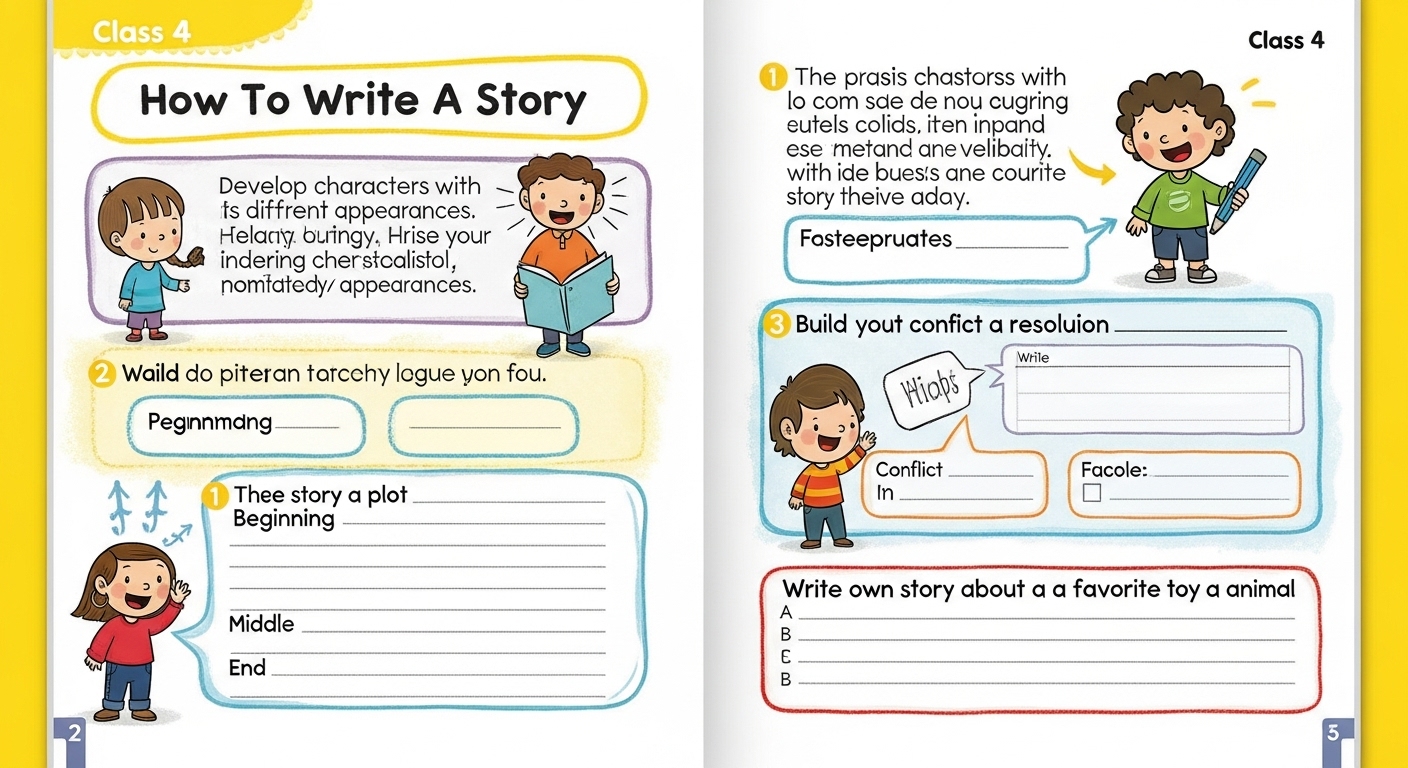
Writing stories is one of the most fun and creative ways to help Class 4 students explore their imagination and improve their writing skills. At this stage, children are learning how to form structured thoughts, describe characters and settings, and express ideas through words. Story writing not only develops language and grammar but also nurtures creativity and emotional intelligence.
Whether it’s for an English assignment, a competition, or just for fun, learning to write a good story in Class 4 sets a strong foundation for future writing. In this blog, we’ll walk you through a complete guide on how to write a story that’s age-appropriate, engaging, and meaningful—with helpful tips that both students and teachers can use.
Plus, if you’re a parent looking to help your child or a teacher seeking structured support, you might consider working with children’s book ghostwriters who specialize in age-specific storytelling.
Why Story Writing Matters at This Age
For students in Class 4, story writing is more than just a school task—it’s a way to organize their thoughts and discover the joy of storytelling. At this age, children are:
- Developing vocabulary and grammar.
- Learning to express emotions in writing.
- Beginning to understand story elements like beginning, middle, and end.
- Able to visualize characters and settings more vividly.
This makes it the perfect stage to introduce structured storytelling techniques and encourage them to create stories they can be proud of.
Key Elements of a Good Story for Class 4
Before diving into the writing process, students should understand the basic elements that make up a good story:
1. Characters
These are the people, animals, or even objects that the story revolves around. In a Class 4 story, characters are usually simple and easy to understand. Encourage students to name their characters and describe them using age-appropriate vocabulary.
2. Setting
Where and when does the story take place? A clear setting helps readers visualize the world of the story. Is it in a forest? A school? On a magic island?
3. Plot
The plot is the series of events that happen in the story. Even for a Class 4 story, there should be a problem, a middle part where something happens, and a resolution.
4. Moral or Message
Many Class 4 stories include a lesson, such as honesty, kindness, or teamwork. This helps students learn values while writing.
Key Steps to Write a Story for Class 4
Let’s now break down how a Class 4 student can write a complete story in a structured and easy-to-follow way.
Step 1: Start with an Idea or a Prompt
Every story begins with an idea. This can be something from daily life, a dream, a picture, or even a story prompt given by the teacher. Encourage kids to think about:
- “What if I had a talking dog?”
- “What happens when I get lost in the zoo?”
- “If I had a magic pencil, what would I draw?”
Creative prompts spark imagination and help children build a world from scratch. If you’re looking for age-appropriate story prompts, story idea development services can help structure ideas in a kid-friendly way.
Step 2: Create Characters and a Setting
Ask your child to decide who the main character is. Is it a boy, a girl, an animal, or even a robot? Once that’s done, help them describe the character’s looks, actions, and personality using simple words.
Then move on to the setting. Is it in a park? At home? In outer space? Encourage sensory descriptions like “It was a bright sunny day” or “The forest was dark and cold.”
Step 3: Plan the Beginning, Middle, and End
A great story has a clear structure:
- Beginning – Introduce the characters and the setting.
- Middle – Something exciting or unexpected happens. This is the problem or the adventure.
- End – The problem is solved, and everything goes back to normal.
Example:
- Beginning: Ravi and his dog Tom went to the beach.
- Middle: Tom got lost while chasing crabs.
- End: Ravi found Tom with the help of a lifeguard.
This simple format helps young writers build confidence and stay focused on the storyline.
Step 4: Add Dialogues and Emotions
Even for young writers, adding short dialogues like “Help!” or “Let’s go!” can make the story more lively. Encourage students to express how the characters feel—“Ravi felt scared when Tom was missing.”
This adds depth to the story and helps readers connect with the characters emotionally. To teach kids how to structure conversations in writing, teachers or parents can refer to expert advice shared in the blog “How to Write a Story for Class 10” which offers adaptable techniques.
Step 5: Use Simple Grammar and Short Sentences
In Class 4, it’s best to use:
- Simple vocabulary.
- Short, clear sentences.
- Correct punctuation (commas, full stops, question marks).
This ensures that stories are readable and age-appropriate. Avoid overloading with complex words or too many ideas at once.
Step 6: Add a Title and Moral (If Needed)
The title should reflect the main idea of the story. Encourage students to come up with fun and catchy titles like:
- “The Day My Shoes Ran Away”
- “The Secret Treehouse”
- “Ravi’s Rainy Adventure”
If the story has a lesson, mention it at the end as a moral. For example, “Moral: Always listen to your parents” or “Be kind to animals.”
Step 7: Edit and Share
Once the story is complete, help your child:
- Re-read the story to check for spelling mistakes.
- Make sure the story flows from start to end.
- Add any missing words or details.
Teachers and parents can assist in polishing the story. For a more polished result, professional book editing services can also be considered, especially when preparing a classroom story collection or school magazine.
Sample Story for Class 4 Students
Title: The Lost Balloon
It was Rina’s birthday. She had ten beautiful balloons. One balloon was red and shiny. As she was walking to the park, the red balloon flew away.
“Oh no!” cried Rina. She ran after it. The balloon went up and up into the sky. Just then, a kind uncle saw her running.
“Are you okay?” he asked.
“My balloon flew away,” said Rina.
The uncle smiled and gave her a new red balloon. Rina was so happy.
Moral: Always be kind. It makes someone’s day better.
Final Tips for Teachers and Parents
- Encourage children to write regularly to improve storytelling.
- Provide positive feedback and celebrate every story, no matter how small.
- Use drawing prompts, story dice, or pictures to inspire ideas.
- Use graphic organizers to help structure ideas visually.
If your child is truly enjoying the process, you can even help them turn their stories into a printed book. Services such as children’s book formatting and design make it easy to create something to treasure.
FAQs About Writing Stories for Class 4
1. What kind of stories should a Class 4 student write?
Simple stories with familiar settings and characters like school, friends, or pets work best. Fantasy and adventure can also be encouraged.
2. How long should a story be?
A typical Class 4 story can range from 150 to 300 words, depending on the student’s writing level.
3. Can stories have pictures?
Yes! Adding drawings can make stories more fun and help younger students express their ideas visually.
Conclusion
Helping a Class 4 student write a story can be a joyful experience filled with creativity and learning. By guiding them through simple steps and encouraging their unique ideas, you’re helping them become better communicators and storytellers. Whether it’s for school, fun, or future publishing, every story matters.
Want to turn your child’s story into a book or get help with writing support? Explore children’s book writing services for professional assistance tailored to young writers.


