 English
 Français
 Deutsch
 Español
 Italiano
 Русский
 Português
 العربية
 Türkçe
 Magyar
 Svenska
 Nederlands
 Ελληνικά
 Български
 Polski
 Gaeilge
 Dansk
 Lietuvių kalba
 Suomi
 Hrvatski
 Română
 Latviešu valoda
 Korean

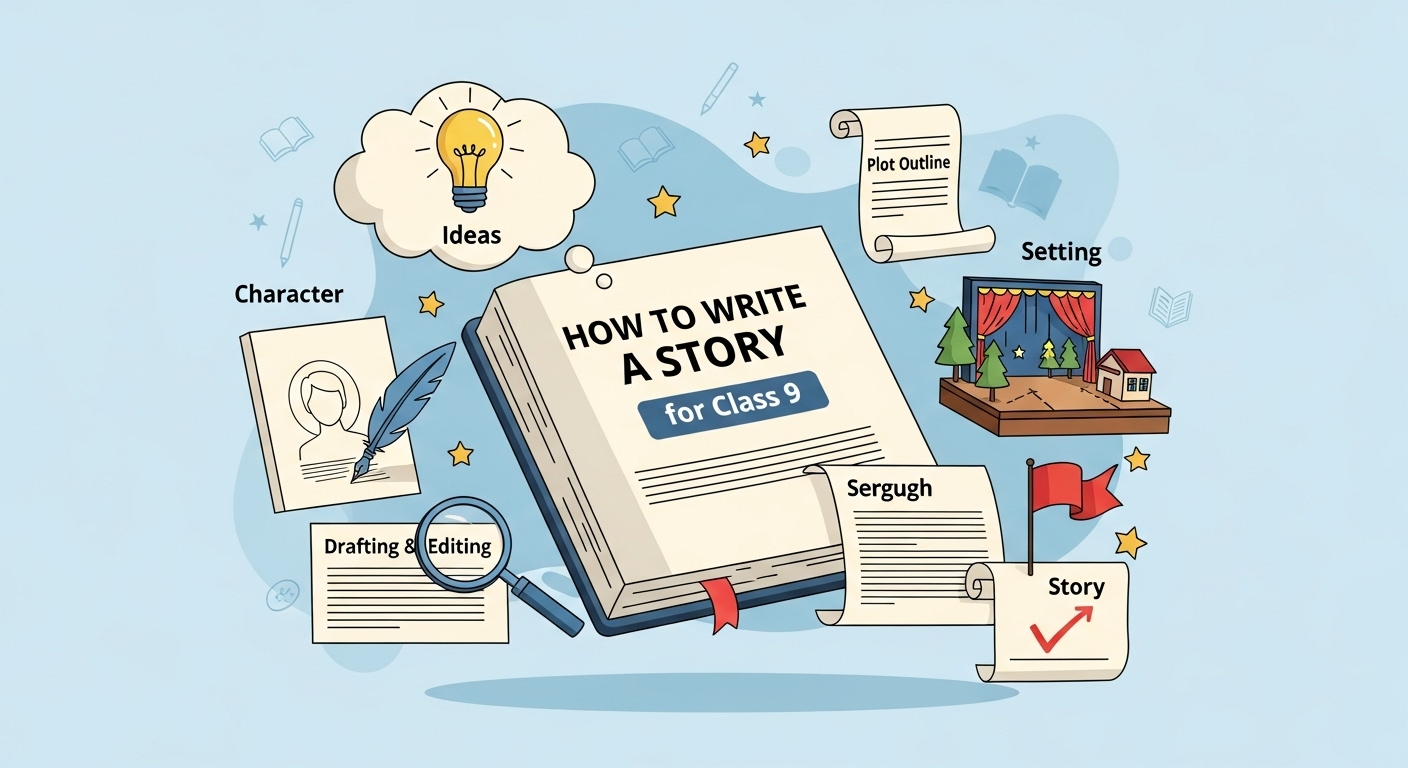
In class 9, story writing is often assessed under exam conditions: you’re given an opening line, a title, an ending or a short outline, a word limit and limited time. Writing a good story on demand is a different skill from writing freely at home. This guide focuses on that skill: how to read the prompt, plan in a few minutes, use every point you’re given, and finish within the word limit. Check your own syllabus for the exact format and marks scheme.
Earlier skills in this series: conflict and twist endings (class 7) and class 8.
The four kinds of prompt
| Prompt | What it requires | Watch out for |
|---|---|---|
| Opening line | Begin with the exact line given | Copying it exactly, then moving the story forward quickly |
| Title | A story that clearly fits the title | Drifting away from the title by the end |
| Ending line | Finish with the given line | Planning backwards so the ending makes sense |
| Outline or cues | Include every point, in order | Skipping a cue, which can cost marks |
A five-minute plan
- Underline the key words in the prompt and the word limit.
- Decide the conflict in one phrase: what goes wrong?
- List three beats: setup, complication, resolution. If you have cues, attach each to a beat.
- Choose one or two characters and give them names.
- Know your last line before you start writing.
Worked example: writing from an opening line
Prompt: Begin with: “The phone rang just as the lights went out.” (about 150–200 words)
Plan: Conflict: Neha is alone, the power is out, and the caller says her grandmother has fallen next door. Beats: (1) the call in the dark; (2) she can’t find the torch and the neighbour’s door is locked; (3) she remembers the spare key under the plant pot, gets in, and calls for help. Last line: she realises she wasn’t scared after all.
Story:
The phone rang just as the lights went out. Neha fumbled for it in the dark. “Beta, it’s Mrs Kapoor next door,” said a shaky voice. “Your grandmother slipped in my kitchen. I can’t lift her, and the door’s locked from inside.”
Neha’s heart pounded. She felt along the shelf for the torch, but it wasn’t there. Outside, the street was black. She ran to the Kapoors’ door and pushed. It didn’t move.
Then she remembered: Grandmother always hid a spare key under the red pot. Her fingers found it in the soil. Inside, by the light of her phone, she found Grandmother sitting on the floor, wincing but smiling. Neha called the doctor, then sat beside her, holding her hand until help came.
When the lights flickered back on, Neha noticed her hands had stopped shaking long ago.
Why it scores well
- It starts with the exact opening line and moves into the problem immediately.
- The complication gets worse (no torch, locked door) before it’s solved.
- The solution comes from the character (the remembered key), not luck.
- The ending shows change without spelling out a moral.
Managing the word limit
- Know roughly how much you write per line on lined exam paper. Count once in practice so you can estimate quickly.
- Spend words on the middle. Keep the setup to two or three sentences.
- Cut summary, keep scenes. One vivid moment beats a paragraph of “and then”.
- Don’t add a second plot to fill space; deepen the one you have instead.
What examiners typically look for
- Content: relevance to the prompt, use of all cues, a clear plot.
- Organisation: logical order, paragraphs, a definite ending.
- Language: accurate grammar, spelling and punctuation, varied vocabulary and sentence length.
- Creativity: a fresh angle on a common prompt.
Practice prompts
- Begin with: “Nobody believed me when I said the house was empty.”
- Title: “The Wrong Bus”.
- End with: “…and that was the last time I ever ignored my sister’s advice.”
- Cues: lost wallet – honest stranger – unexpected reward – lesson learnt.
Final-minute checklist
- Did I use the prompt exactly as given?
- Did I include every cue?
- Is it within the word limit?
- Is there a clear conflict and resolution?
- Have I checked tenses, speech marks and spelling?
Next: in class 10, the focus moves to theme, voice and revision.
Writing something longer than an exam story? Ghostwriting LLC’s writers and editors can help.


