 English
 Français
 Deutsch
 Español
 Italiano
 Русский
 Português
 العربية
 Türkçe
 Magyar
 Svenska
 Nederlands
 Ελληνικά
 Български
 Polski
 Gaeilge
 Dansk
 Lietuvių kalba
 Suomi
 Hrvatski
 Română
 Latviešu valoda
 Korean

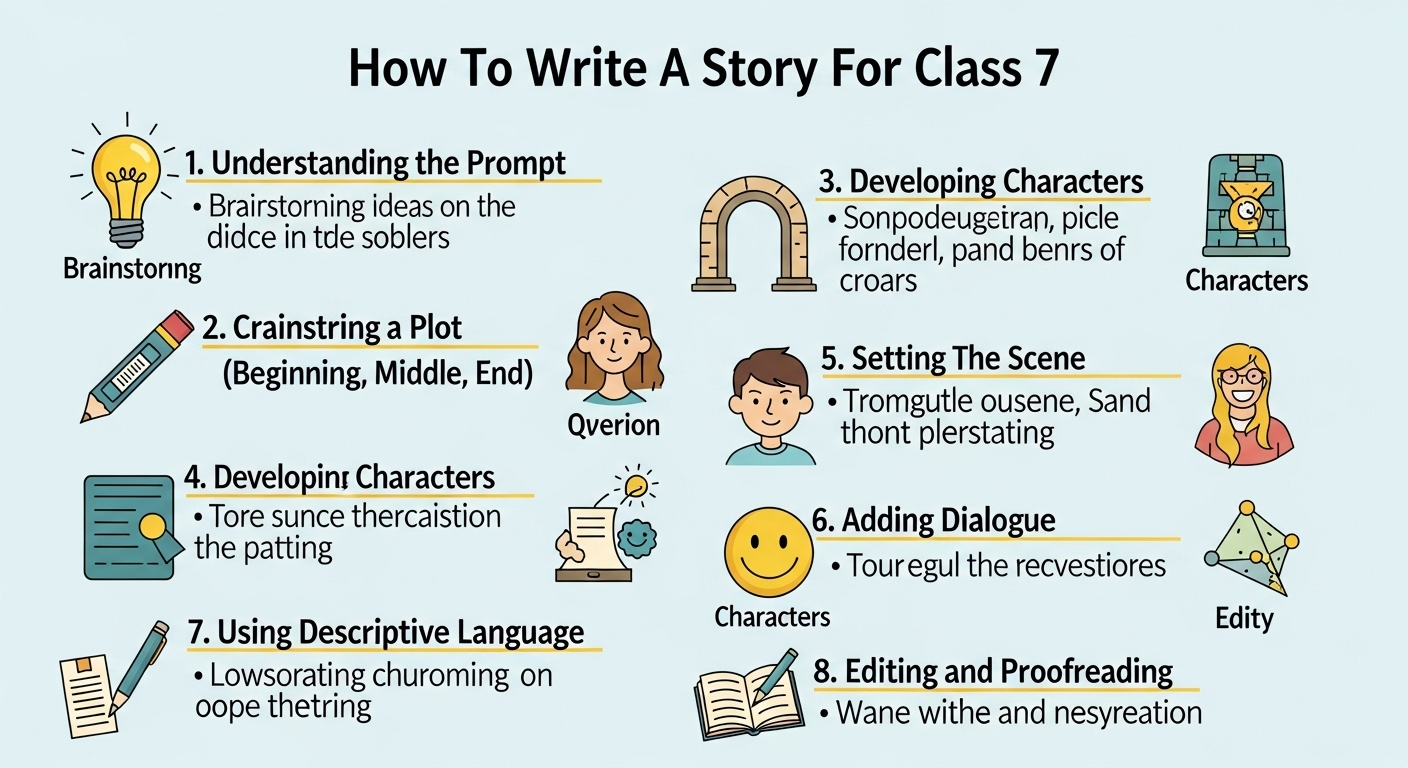
By class 7, students can usually write a story with a clear shape, real characters and good description. What lifts a class 7 story is conflict (a problem that’s genuinely hard to solve) and an ending that feels earned, sometimes with a surprise. This guide covers the main types of conflict, how to build tension step by step, how to write a twist that’s fair, and the endings examiners and teachers tend to reward.
Earlier skills in this series: structure, characters and dialogue and description.
Four kinds of conflict
| Type | The character struggles against… | Example |
|---|---|---|
| Person vs person | Another character | A bully, a rival, a stubborn parent |
| Person vs nature | Weather, animals, the environment | A flood, getting lost in a forest |
| Person vs society | A rule, tradition or group | A school rule that seems unfair |
| Person vs self | Their own fear, guilt or doubt | Telling the truth after breaking something |
The strongest stories often combine two: an outside problem that also forces the character to face something inside.
Building tension: the staircase
Instead of solving the problem in one step, make it harder each time the character tries:
- First attempt fails in a small way.
- Second attempt makes things worse.
- The darkest moment: it seems impossible.
- The turn: the character uses something they learned, noticed or found earlier to solve it.
Step 4 is the key. If the solution comes from nowhere (a stranger appears, it was all a dream), the reader feels cheated.
Writing a fair twist
A good twist surprises the reader but makes sense when they think back. To make it fair:
- Plant a clue early that seems unimportant at the time.
- Distract the reader with something more obvious.
- Reveal at the end, and let the clue click into place.
Sample story: The Missing Medal
The sports day medals were locked in Mr Das’s cupboard, and on Friday morning one was gone. Everyone looked at Rohan. He had lost the 100 metres by a hair, and he had been seen near the staffroom at lunch.
Rohan’s best friend Isha didn’t believe it, but the evidence piled up. Rohan’s shoes had chalk dust on them, just like the floor outside the cupboard. When Mr Das asked him to empty his bag, Rohan refused, his face red. Even Isha began to doubt him.
That afternoon Isha noticed something she’d seen in the morning without thinking about it: the classroom crow on the window ledge, which loved anything shiny, had been strutting about with a scrap of red ribbon. She climbed to the gutter outside the window. Tucked into a messy nest was the medal, its ribbon chewed.
And Rohan’s bag? It held a homemade card for Isha’s birthday, which he hadn’t wanted anyone to see.
Why the sample works
- Two conflicts: person vs person (the accusation) and person vs self (Isha’s doubt).
- The staircase: the evidence gets worse each time.
- A fair twist: the crow and the red ribbon were mentioned before the reveal.
- A second, smaller surprise explains Rohan’s refusal and adds warmth.
Endings that work
- Resolved: the problem is solved and the character has changed in some way.
- Twist: a fair surprise, as above.
- Circular: the story ends where it began, but the character sees it differently.
- Reflective: a final line showing what the character learned, without preaching. “Isha never doubted a friend so quickly again” is fine; a paragraph-long moral is not.
Tips for exams and timed writing
- Spend the first few minutes planning: conflict, three steps, ending.
- Stay within the word limit given; a complete short story scores better than a long unfinished one.
- If you’re given opening lines or an outline, use every point and keep the same characters.
- Leave a few minutes to check spelling, punctuation and speech marks.
Checklist
- Is there a clear conflict, and could I name its type?
- Does the problem get harder before it’s solved?
- Does the solution come from the character, not luck?
- If there’s a twist, did I plant a clue earlier?
- Does the ending show change or understanding?
Want help developing a young writer’s story into a book? Ghostwriting LLC’s writers can help.


