 English
 Français
 Deutsch
 Español
 Italiano
 Русский
 Português
 العربية
 Türkçe
 Magyar
 Svenska
 Nederlands
 Ελληνικά
 Български
 Polski
 Gaeilge
 Dansk
Dansk Lietuvių kalba
 Suomi
Suomi Hrvatski
 Română
 Latviešu valoda
 Korean
IngramSpark Royalty Calculator
IngramSpark Royalty Calculator
Introduction
When you choose to self-publish a book, one of your biggest and most foundational questions is: “How much will I actually take home per copy?” Navigating the intricate economics of modern publishing can feel overwhelming. Understanding your royalty, publisher compensation, and net earnings is crucial before setting your price and launching your marketing campaigns. Factors like print cost, wholesale discount, and whether or not the book is returnable all heavily influence your final earnings. That’s where the IngramSpark royalty calculator—also known as the publisher compensation calculator—comes in as an indispensable guide. This tool uses a specific formula that combines various inputs to show what you’ll earn on each sale.
In this article, we’ll explain how it works, what inputs matter, how to handle returns, and why there are differences across markets. You’ll also learn strategies to maximize earnings, spot pitfalls to avoid, and explore real-world examples to help you make informed decisions and boost your profits. Whether you are distributing standard paperbacks or high-end hardcovers, mastering this math is your gateway to commercial viability.
What Is the IngramSpark Royalty / Compensation Calculator?
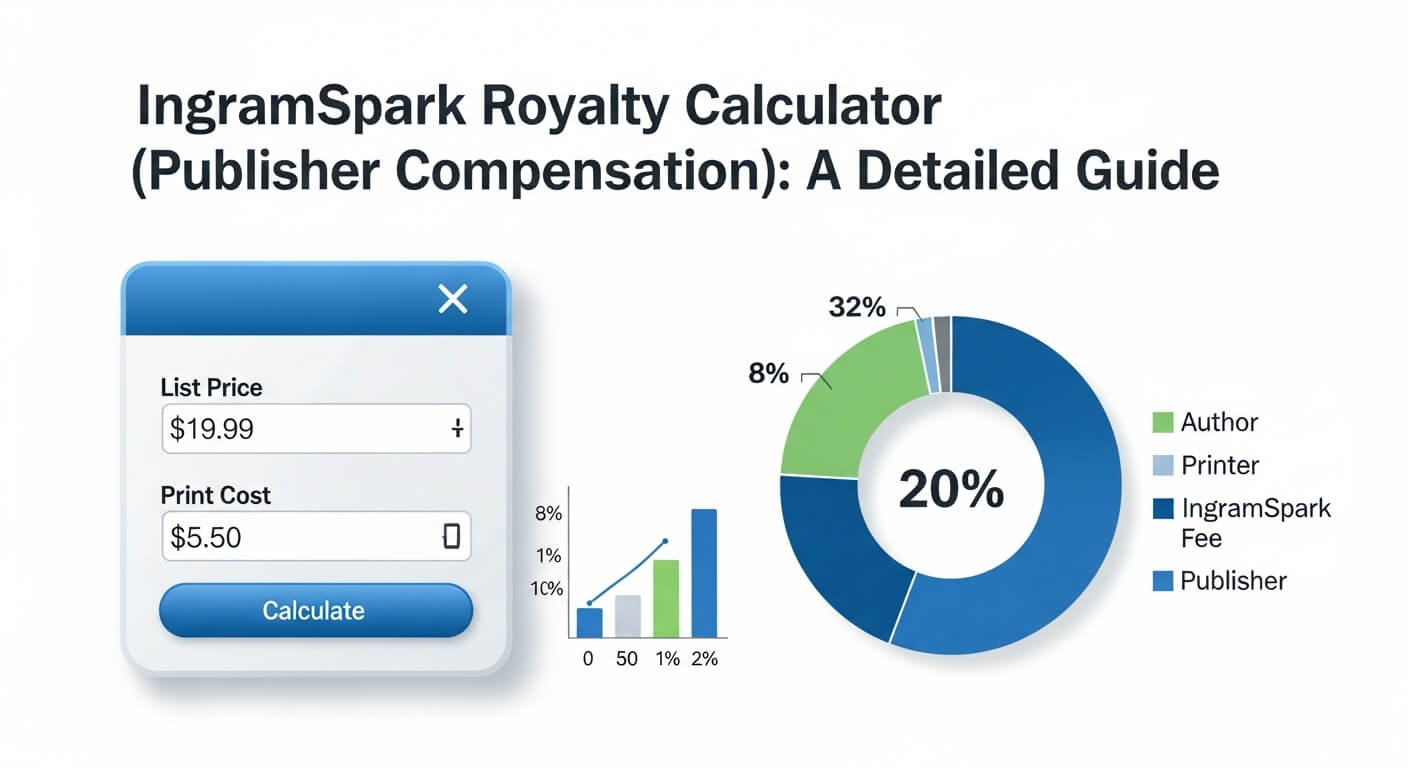
IngramSpark doesn’t always use the term “royalty”; instead, they refer to publisher compensation for print sales. But essentially, the royalty calculator is a digital tool to estimate how much money you (the author or publisher) receive after all deductions when a print book sells via IngramSpark’s vast distribution network. This distinction between traditional “royalties” (which are typically a percentage of sales paid by a third-party publisher to an author) and “publisher compensation” (which is the net revenue remaining after a print-on-demand printer-distributor deducts manufacturing and retail fees) is highly important for indie publishers to grasp.
In practical terms, the calculator takes into account:
- The list price you set in your dashboard
- The wholesale discount (i.e., the discount you grant to retailers so they have an incentive to display your work)
- The print cost (determined by physical metrics such as page count, trim size, color or black & white interior, and paper weight)
- Any fixed surcharges or fees (e.g., print service surcharges or localized logistics fees)
- Returnability status (i.e., how retail returns dynamically impact your final financial settlement)
- Occasionally, market access or distribution fees which vary depending on region
Using those, it outputs a per-copy compensation (royalty) and breakdown. IngramSpark provides a “Compensation Calculator” in its dashboard, allowing publishers to map out their expected revenue before final file upload and listing activation. In effect, the royalty calculator answers: “After bookstores, print costs, discounts, and returns, how much am I left with per sale?”
IngramSpark Pricing Calculator
The IngramSpark pricing calculator is an essential tool for authors to determine the manufacturing costs of their books before they hit the market. Unlike a simple royalty estimator, a pricing calculator focuses on the physical specifications of your title—such as trim size, binding type (hardcover vs. paperback), and interior color options. By analyzing these production costs upfront, you can set a list price that covers printing expenses while remaining attractive to readers. This tool is particularly useful for balancing quality and profitability; for example, you might discover that switching from premium color to standard color allows for a significantly lower retail price, making your book more competitive in a crowded marketplace. Selecting standard white paper over cream can also shave off valuable cents per copy, which adds up to substantial profit increases over hundreds of transactions.
To help authors understand these variations, let’s explore how different print specifications directly influence the baseline printing and production costs. Standardizing your book’s physical profile ensures you do not inadvertently raise the retail floor price beyond what your genre’s audience is willing to pay.
Key Variables in the Royalty Equation
To use or understand the royalty calculator well, you need to know the variables. Let’s break each down in detail:
1. List Price (Retail Price / MSRP)
This is the price the consumer sees (before sales taxes). It’s the starting point for all calculations. You choose it in each IngramSpark market (US, UK, EU, Australia, etc.). Selecting an optimized list price requires a delicate balance: it must be competitive with top-selling titles in your genre while leaving enough margin to absorb retail discounts and printing costs.
2. Wholesale Discount (Retail Discount to Booksellers)
Booksellers don’t pay list price—they expect a discount to cover their overhead and generate their own retail margin. That discount might range from 30% to 55%, though 50–55% is typical in many professional markets. IngramSpark recommends a 55% discount as a standard to ensure physical bookstores are receptive to ordering your book.
If you offer a 55% discount, the bookseller pays you 45% of list price (i.e., the net to the “wholesale side”). If you offer a lower discount (say 40%), you capture more per sale, but many brick-and-mortar bookstores may not accept your book at that discount, limiting your distribution strictly to online retailers.
3. Print Cost (Production Cost)
This is how much it costs IngramSpark to print and bind one copy, given your book’s exact specifications:
- Page count
- Trim size (e.g., 5″×8″, 6″×9″, etc.)
- Color vs black & white interior
- Paper type (cream, white, thickness)
- Cover type (matte, gloss, laminated, hardcover vs paperback)
Books with many pages, color interiors, large trim sizes, or premium paper have higher print costs. Some estimates suggest a 200‑page black & white paperback might cost $3.50 to $5.00 to print, whereas a premium color hardcover can easily exceed $12.00 to $15.00 in production costs alone.
4. Fixed Surcharges, Fees & Market Access Costs
- The print service surcharge is a fixed fee per copy in some cases (e.g., in their Share & Sell e-commerce mode).
- Entering 2026 and heading into 2027, IngramSpark continues to maintain its 1% market access fee on list price in some markets—meaning 1% of the list price is systematically deducted from your gross distribution compensation to fund global distribution logistics and network maintenance.
- In the past, IngramSpark also charged setup fees for new titles and revisions (e.g., $49 for print titles, $25 for ebooks), although free promotions, title uploads, and fee waivers are now widely available for active publishers.
5. Returns / Returnability
This is one of the trickiest variables. If you allow returns (i.e., bookstores can send back unsold copies), you bear the cost when books are returned. In traditional retail distribution models, brick-and-mortar booksellers demand a return clause. The effect of returns can drastically reduce your net compensation and can even result in a negative balance on your publisher statement. We will explore returns in depth below, because many authors underestimate how severely returns can affect net earnings.
The Basic Royalty / Compensation Formula (Ignoring Returns)
First, let’s look at the simplified version, ignoring returns, which gives your gross compensation per sale. A widely used formulation is:
Royalty (per copy) = (List Price × (1 – Wholesale Discount)) – Print Cost – Surcharges & FeesAlternatively:
Publisher Compensation = Net to Retailer – Print Cost – Fixed FeesIn notation:
- L = List Price
- D = Wholesale Discount (e.g., 0.55 for 55%)
- P = Print Cost (including any surcharge or fee)
Then:
R = L × (1 – D) – P
In many sources, the formula is given similarly. Let’s look at an illustrative calculation to cement this formula in practice.
Example:
- Suppose you set L = $15
- You offer D = 55% discount (meaning 0.55)
- Suppose your print + surcharge cost is P = $4.50
Then:
- Retailer pays: L × (1 – D) = 15 × 0.45 = $6.75
- Your royalty = $6.75 – $4.50 = $2.25
That’s the gross compensation. In many cases, IngramSpark’s compensation calculator outputs a similar per‑copy compensation. However, always remember: this does not yet include the impact of returns, which represents a massive risk vector for physical store campaigns.
Returns: The Hidden Risk and Its Effect
Allowing returns means bookstores can send unsold copies back (usually within a fixed period, typically up to 180 days). This practice dates back to the Great Depression as a way to convince stores to stock unproven authors. Today, if you choose to allow returns on your IngramSpark dashboard, you are legally agreeing to purchase back these books from the retailer.
When returns happen:
- You must refund the wholesale price of the book to the bookseller.
- You might also pay for return shipping or handling fees, depending on your choices.
- You lose your earlier “royalty” on that return and must absorb the physical print cost.
In effect, each returned copy can cost you the print cost (and often more, when shipping is considered).
How Returns Affect Net Compensation
Let’s define:
- RR = “royalty” for a returned copy
- R = your gross royalty per sold copy (from the formula above)
It can be shown (via algebra) that:
RR = – P (i.e., a returned copy costs you the print cost)
In other words, for any copy returned, you lose the print cost (plus other transaction costs) as a negative balance. Suppose you sold 100 copies, and 30 copies were returned (a 30% return rate). Then:
- 70 copies are truly sold → you get R per copy
- 30 copies are returned → you lose P per copy
So total net:
Total net royalties = 70 × R + 30 × (–P)Divide by 100 (number of books) to get net royalty per copy sold (allowing for returns):
Net_Royalty_per_copy = (0.70 × R) – (0.30 × P)Or, using the L, D, P notation:
Net_Royalty_per_copy = ( (1 – Return_Rate) × (L × (1 – D)) ) – PWhere “Return_Rate” is the fraction of sold copies that are returned. As a more precise derivation, many authors use:
Net_Royalty = (1 – return_rate) × (L × (1 – D)) – PThis accounts for the fact that returns reduce the effective revenue base. Let’s look at a realistic numerical scenario to show how dangerous returns can be to your bottom line:
Illustrative Example:
- L = $13.99
- D = 55%
- P = $5.96
- Return Rate = 30%
Compute:
- Retailer pays: 13.99 × (1 – 0.55) = 13.99 × 0.45 = $6.2955
- R (gross royalty) = 6.2955 – 5.96 ≈ $0.34 (this matches Ingram’s calculator for that input)
- Net per copy (allowing returns) = (0.70 × 6.2955) – 5.96 = 4.40685 – 5.96 = –$1.55315
In other words, with 30% returns, you’d lose $1.55 per copy on average! This is a real risk many authors underestimate. Because of this, some authors decide not to allow returns at all (or limit return windows). But that can reduce bookstore willingness to stock your title. It’s a tradeoff.
E‑Book Royalties via IngramSpark
While the big complexity lies in print, it’s worth covering e‑book royalties too, for completeness. When you self-publish a book, digital distribution offers a parallel, highly efficient stream of passive income. E-books bypass physical manufacturing and shipping costs completely, resulting in highly stable royalty margins:
- IngramSpark typically pays 85% of net revenue (i.e., after the retailer’s cut) for e‑book sales.
- However, many authors and commentators estimate that, overall, ebook royalty via IngramSpark ends up around ~40% of list price, depending on retailer contracts, fees, and global distribution agreements.
- Some sources also mention that IngramSpark charges setup or revision fees for ebooks (e.g., $25) in certain circumstances, though modern dashboard promotions often eliminate these.
Because ebook royalty structures are generally simpler (no print cost, no returns), many authors publish their ebooks via direct retailers (Amazon KDP, Apple Books, Kobo, etc.) and use IngramSpark mainly for print distribution.
Example Scenarios: How the Numbers Shift
Let’s walk through a few hypothetical scenarios to illustrate how different inputs change your compensation.
Scenario A: Conservative, industry-standard settings
- List Price, L = $20
- Wholesale Discount, D = 55%
- Print Cost + surcharge, P = $6.00
- Return Rate = 25%
Gross royalty (ignoring returns):
- Retailer pays: 20 × 0.45 = $9
- R = 9 – 6 = $3
Net (allowing returns):
- Net per copy = (0.75 × 9) – 6 = 6.75 – 6 = $0.75
So with a 25% return rate, your margin is thin.
Scenario B: More aggressive discount control
- L = $20
- D = 45% (booksellers get a 45% discount)
- P = $6.00
- Return Rate = 20%
Gross royalty:
- Retailer pays: 20 × 0.55 = $11
- R = 11 – 6 = $5
Net:
- Net per copy = (0.80 × 11) – 6 = 8.8 – 6 = $2.80
Better—but some retailers may reject lower discount terms or refuse returns in that case.
Scenario C: E‑commerce / direct sales via Share & Sell mode
IngramSpark’s Share & Sell e‑commerce mode allows you to bypass wholesale discount entirely; you get:
List Price – Printing Cost – Fixed Surcharge
For example:
- L = $16
- Print cost = $4.50
- Surcharge = $3.50
Royalty = 16 – 4.50 – 3.50 = $8.00
(Note: this assumes you are handling the customer sales directly; shipping and taxes are paid by buyer)
That’s significantly better than via wholesale. The downside is fewer retailers or bookstores accessing that route, and you must drive customer traffic.
Choosing the Right Settings & Strategy
Given how sensitive your net compensation is to these variables, here’s how to approach it:
1. Decide whether to allow returns (or in what window)
- Many traditional bookstores require returns to carry a title. If you disable returns, bookstores may refuse to carry your book.
- However, returns are costly and can wreck your profits. Some authors start without returns enabled, then later allow them selectively.
- Be careful: even after you disable returns, bookstores may still return copies for a period (some report up to 180 days) and you might be liable.
2. Choose a wholesale discount that balances appeal and margin
- 50–55% is common and widely accepted by bookstores.
- Lower discounts (30–45%) boost your margin but risk rejection by retailers.
- In many markets, IngramSpark enforces a minimum discount (e.g., 40%)—you can’t go below it.
3. Optimize print cost
- Reduce page count if possible.
- Use black & white interior rather than color, unless your content demands it.
- Use standard trim sizes and standard paper types.
- Avoid premium materials where unnecessary.
Every dollar shaved from print cost directly adds to your royalty.
4. Factor in fixed surcharges and fees
Don’t forget to include the print service surcharge, market access fee, or other per‑copy fees in your calculations.
5. Build in a “buffer” for returns
Because returns can be volatile, treat part of your projected royalty as margin buffer. In practice, many authors assume a 20–30% return rate when pricing.
6. Run multiple “what if” scenarios
Make a spreadsheet and vary L, D, P, and return rate. See which combinations still give you a positive net royalty.
7. Use direct / share & sell channels where possible
Whenever you can sell directly (via share links or author website), bypass wholesale margins. That improves your take substantially. (As shown in scenario C above)
8. Review your pricing periodically
Print costs, distribution policies, or minimum discount levels may change over time. Revisit your list price and discount every year or two.
Common Pitfalls & Mistakes to Avoid
- Ignoring returns and computing royalty as if all copies are sold with no returns. That gives an overly optimistic number.
- Underpricing, trying to make your book more “affordable” but ending up with negligible margin.
- Setting too low a discount that bookstores refuse to stock your book.
- Neglecting fixed fees or surcharges—they can eat into your numbers significantly.
- Failing to account for market access or currency conversion in non‑U.S. markets.
- Not revisiting settings after changes—if you modify your page count or book specs, re-run your calculation.
- Relying entirely on retail routes when you could use direct sales—taking advantage of share & sell or author direct routes can boost margin.
Real‑World Considerations & Community Insights
- Many authors report “horror stories” where returns vaulted unexpectedly high and significantly cut profits.
- Some authors choose not to allow returns, accepting that their books won’t be stocked in many brick & mortar stores.
- Others split distribution: allow returns for big accounts, but disable returns for smaller orders or special editions.
- In recent years, IngramSpark has increased minimum wholesale discounts (e.g., raising floor to 40% in some markets, reducing flexibility).
- Some authors use both KDP and IngramSpark—using KDP for Amazon print royalty advantage, and IngramSpark for bookstore / library access.
One community member on Reddit described:
“If a store orders 10 copies and returns 8, you’re responsible for all fees (including printing and shipping).”
These real stories underscore that distribution choices have financial consequences.
Multiple Markets & Currency Considerations
IngramSpark operates in multiple markets (US, UK, EU, Australia, etc.). For each:
- The print cost (P) is different (local cost, local currency)
- You must enter list price (L) in that market’s currency
- Fees, surcharges, and discounts may vary by market
Thus, you’ll want to run separate compensation calculations per market. Blue Paper’s article shows exactly this: enter the book setup in the UK market, get the UK print charge in £, then translate your royalty formulas. When optimizing across markets, you may set slightly different list prices in each market to maintain comparable margins.
Long Article Summary / Step‑by‑Step Approach
Here’s a condensed roadmap you can follow when using the royalty calculator for your own book:
- Define your book specs (page count, trim size, color vs black & white, paper type).
- Decide your strategy: do you allow returns? what wholesale discount will you set?
- Get print cost for those specs (IngramSpark’s calculator will show it).
- Choose various list prices and run scenarios.
- Compute gross royalty using the formula: R = L × (1 – D) – P
- Apply return rate assumption to compute net royalty.
- Compare results across scenarios and pick pricing that gives you a healthy margin while being market‑acceptable.
- Explore direct / share & sell mode to bypass wholesale discount where feasible.
- Review periodically—costs, policies, or market conditions may change.
- Consider splitting distribution routes—KDP for Amazon, IngramSpark for bookstores/libraries.
By doing this, you can make informed pricing decisions rather than guessing.
Sample Full Calculation Example
Let me walk you through a full example from scratch.
Book specs:
- 250 pages, black & white interior
- Trim size: 6″ × 9″ paperback
- Paper: standard white
- Region: U.S. market
Scenario parameters:
- List price (L): $18.99
- Wholesale discount (D): 55%
- Print cost + surcharge (P): $5.20 (estimated via IngramSpark calculator)
- Return rate assumption: 25%
Step 1: Retailer pays: 18.99 × 0.45 = $8.5455
Step 2: Gross royalty: 8.5455 – 5.20 = $3.3455
Step 3: Net royalty per copy (accounting for returns):
- Net = (0.75 × 8.5455) – 5.20 = 6.409125 – 5.20 = $1.2091
So you’d expect about $1.21 on average per copy sold, with a 25% return assumption. If return rates rise, your margin slides; if you choose to sell more directly, your margin can improve.
You can repeat the above with L = 20.99, D = 50%, etc., and decide which gives you enough cushion.
FAQs
What is the IngramSpark Royalty Calculator?
The IngramSpark Royalty Calculator, or Publisher Compensation Calculator, is a digital tool designed to estimate net profits. When you self-publish a book, this estimator evaluates list price, wholesale discounts, and production specifications to determine exact publisher compensation after subtracting print costs.
How does the IngramSpark royalty formula work?
The IngramSpark royalty formula determines earnings by subtracting unit printing fees and retail discounts from your retail list price. To compute this yourself, multiply your retail price by your remaining wholesale percentage, then deduct physical production costs to calculate the standard net publisher compensation per copy.
What is the difference between wholesale discount and returns?
A wholesale discount is the retail price percentage granted to bookstores to motivate stocking. Conversely, returns occur when retailers return unsold stock, forcing you to refund the wholesale price and absorb printing costs, which can turn positive royalties negative for those who self-publish a book.
What is a good wholesale discount for IngramSpark?
An industry-standard fifty-five percent wholesale discount is highly recommended for physical bookstore distribution. While lowering your discount to forty percent helps maximize margins when you self-publish a book, it usually discourages brick-and-mortar retailers from ordering, stocking, or showcasing your title.
How can I increase my royalties on IngramSpark?
To increase your royalties, optimize physical specifications by reducing page counts, utilizing black-and-white interiors, and choosing standard trim sizes. Additionally, bypass wholesale discounts by leveraging direct sales or IngramSpark’s Share and Sell model to secure higher margins for every copy you distribute.
Final Thoughts & Recommendations
The IngramSpark royalty (publisher compensation) calculator is a powerful tool—but it’s only as good as your assumptions (especially return rate). As we navigate the complex, rapidly shifting terrain of the book industry in 2026 and look forward to 2027, maintaining absolute command over your margins is the single most important factor determining your long-term viability as an independent author or publisher.
- Always factor in returns realistically; never assume zero returns.
- Use direct or share & sell channels where possible to bypass wholesale discounts.
- Maintain flexibility: book retailers’ expectations, discount norms, and market policies can change.
- Consider splitting distribution across platforms to maximize each route’s strengths.
- Above all, run multiple pricing & discount scenarios so you understand which combinations yield sustainable margins.
If you like, I can build a ready‑to-use spreadsheet (Excel or Google Sheets) with built‑in formulas for your book (you give me page count, color, target markets), so you can play “what if” yourself. Would you like me to generate that for you now?


