 English
 Français
 Deutsch
 Español
 Italiano
 Русский
 Português
 العربية
 Türkçe
 Magyar
 Svenska
 Nederlands
 Ελληνικά
 Български
 Polski
 Gaeilge
 Dansk
Dansk Lietuvių kalba
 Suomi
Suomi Hrvatski
 Română
 Latviešu valoda
 Korean
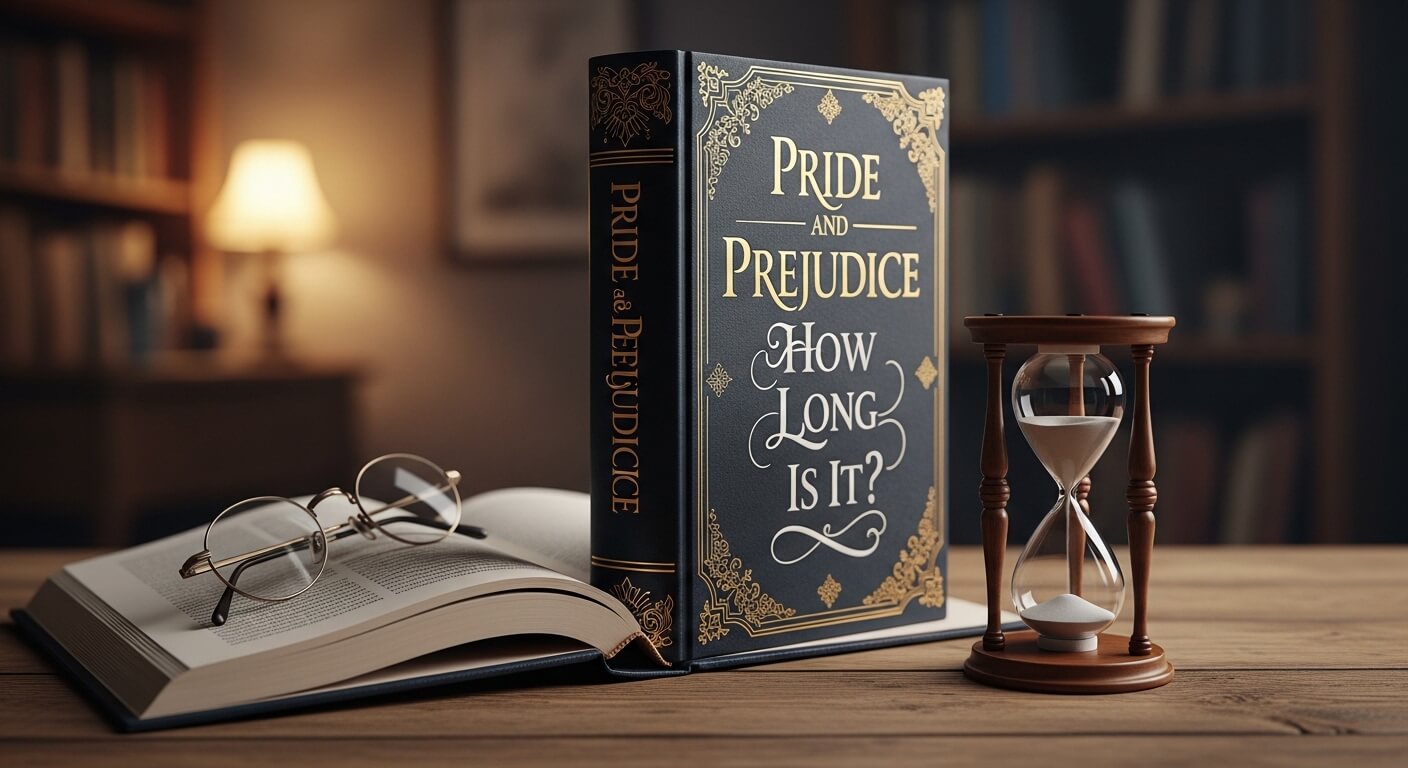
On average, Jane Austen’s “Pride and Prejudice” is between 270 and 430 pages long, depending largely on the publisher, font size, and edition. The classic novel features exactly 61 chapters and contains an estimated total word count of 122,189 words. For an average adult reading at a pace of 250 words per minute, it takes approximately 8 hours and 15 minutes to complete the book from cover to cover.
Committing to a piece of classic 19th-century literature often brings a moment of hesitation. Before diving into the sweeping romances and biting social satire of Regency-era England, modern readers naturally want to gauge the time investment. Understanding the exact length and structural pacing of the story not only helps you plan your reading schedule but also sets the right expectations for digesting Jane Austen’s brilliantly crafted prose.
Deconstructing the Metrics of Austen’s Masterpiece
When analyzing the length of a historical novel, standard page counts can be deceiving. Physical book dimensions, formatting choices, and scholarly introductions drastically alter the thickness of the book on your shelf. To get a true sense of the novel’s scope, we have to look beyond the spine and examine the raw data of the text.
The Exact Word Count Unveiled
At approximately 122,189 words, “Pride and Prejudice” sits comfortably in the standard length for a robust, standalone novel. To put this into perspective, modern fiction typically ranges between 80,000 and 100,000 words. Austen’s work is slightly lengthier than a typical modern thriller but significantly shorter than massive epic fantasies or the sprawling, serialized Victorian novels of Charles Dickens. This specific word count provides a perfect canvas for deep character development—particularly the evolving dynamic between Elizabeth Bennet and Fitzwilliam Darcy—without overstaying its welcome.
Page Counts Across Different Editions
Because the book is in the public domain, thousands of publishers have printed their own versions. Here is a breakdown of what you can expect based on your chosen format:
- Mass Market Paperbacks: Usually printed tightly with smaller fonts, these editions typically run between 350 to 380 pages.
- Hardcover and Trade Paperbacks: Featuring larger margins and more comfortable text sizes, these generally range from 270 to 320 pages.
- Annotated and Academic Editions: Norton Critical Editions or Penguin Classics often include historical footnotes, critical essays, and glossaries. These can easily exceed 500 pages, though the core story remains the same length.
- Digital and E-Readers: On a Kindle or iPad, page count is entirely dependent on your personal font size and line spacing settings.
Calculating Your Personal Reading Time
Knowing the word count allows us to calculate highly accurate reading times based on individual literacy speeds. While the global average reading speed for adults is around 250 words per minute (WPM), digesting the syntax of the early 1800s may naturally slow your pace.
If you are a voracious reader who consumes fiction at 300 WPM, you could finish the story in roughly 6 hours and 45 minutes—easily achievable over a single, cozy weekend. The average reader (250 WPM) will need about 8 hours and 15 minutes. However, if you prefer to take your time to appreciate the complex vocabulary and nuanced dialogue (reading at about 150 WPM), expect to spend closer to 13.5 hours immersed in the world of Longbourn and Pemberley.
The Audiobook Alternative
For those who prefer auditory storytelling, unabridged audiobooks offer a standardized duration. Professional narrations of “Pride and Prejudice”—such as the highly acclaimed performances by Rosamund Pike or Juliet Stevenson—typically clock in at just over 11 hours and 30 minutes. Listening at a 1.2x or 1.5x speed can comfortably reduce this to an 8-to-9-hour experience without losing the charm of the performance.
Structural Pacing: Volumes and Chapters
The way a book is divided significantly impacts how fast it feels to read. Modern readers are accustomed to seeing the novel divided into 61 distinct chapters. However, when Thomas Egerton first published the novel in 1813, it was bound as a three-volume set—a standard publishing format of the era designed for circulating libraries.
In the original structural framework:
- Volume I contained 23 chapters, ending just after the Netherfield ball and Mr. Collins’s disastrous proposal.
- Volume II comprised 19 chapters, focusing heavily on the evolving tension and a critical letter from Mr. Darcy.
- Volume III wrapped up the story with 19 chapters, resolving the family scandals and securing the romantic conclusions.
Today’s continuous 61-chapter format makes the book highly digestible. The chapters are relatively short—averaging around 2,000 words each. This allows readers to easily consume a chapter or two during a daily commute or right before bed, creating a brisk, episodic momentum.
Why the Novel Reads Faster Than You Might Think
Despite its age and 122,000-word length, “Pride and Prejudice” boasts a surprisingly rapid narrative velocity. Unlike many of her contemporaries, Jane Austen did not rely on pages of dense, sweeping descriptions of landscapes or hyper-detailed architectural breakdowns. Instead, the novel is heavily propelled by dialogue.
The sharp, witty banter between characters drives the plot forward, making the pages turn much faster than they would in a heavily descriptive text. The dialogue-rich structure requires active cognitive engagement, drawing the reader directly into the drawing-room politics and societal maneuvering.
For students, balancing a rigorous academic syllabus means organizing study time with pinpoint efficiency. Shifting mental gears from analyzing the witty social commentary of Elizabeth Bennet to studying complex quantitative data sets using an AP statistics book requires incredible mental agility. Knowing the exact time commitment required for your literary assignments ensures you can compartmentalize your studies without falling behind in other challenging subjects.
Five High-Intent FAQs About the Length of Pride and Prejudice
How many chapters are in Pride and Prejudice?
There are exactly 61 chapters in modern editions of “Pride and Prejudice,” originally split across three volumes upon its publication in 1813.
Is Pride and Prejudice considered a hard book to read?
While the Regency-era vocabulary and complex sentence structures present a slight learning curve, the heavy reliance on dialogue and engaging romantic plot make it highly accessible for most high school and adult readers.
How long is the Pride and Prejudice audiobook?
An unabridged, professionally narrated audiobook version of the novel generally lasts between 11 hours and 11 hours and 45 minutes.
How many pages was the original 1813 edition?
The original first edition was published in three separate volumes, collectively totaling roughly 825 pages due to the specific typesetting, wide margins, and smaller page dimensions of the era.
What is the reading level of Pride and Prejudice?
The novel sits at an 11th to 12th-grade reading level (Lexile measure around 1060L), making it ideal for high school students, college literature courses, and adult readers.
Disclaimer: Ghostwriting LLC provides information for educational purposes only. Your own research is necessary, as we do not guarantee anything. Our services include publishing support, ghostwriting, marketing, and editing to help authors prepare their work for submission.


