 English
 Français
 Deutsch
 Español
 Italiano
 Русский
 Português
 العربية
 Türkçe
 Magyar
 Svenska
 Nederlands
 Ελληνικά
 Български
 Polski
 Gaeilge
 Dansk
Dansk Lietuvių kalba
 Suomi
Suomi Hrvatski
 Română
 Latviešu valoda
 Korean
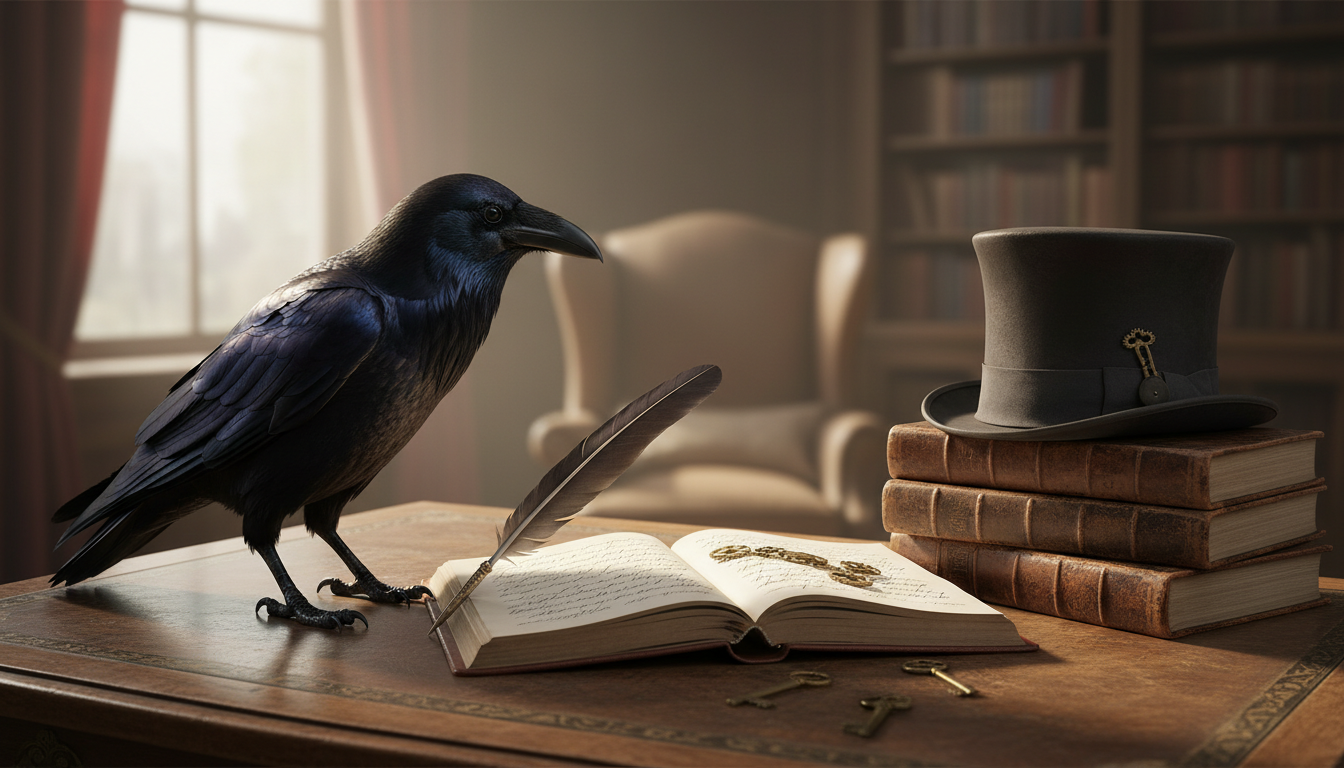
Why is a raven like a writing desk? Originally, Lewis Carroll wrote this famous Mad Hatter riddle without an answer, intending it to be a piece of pure literary nonsense. The meaning behind the riddle is that it has no inherent meaning; it is a paradox designed to frustrate Alice and subvert the logical expectations of Victorian literature. However, due to relentless public demand, Carroll later provided a definitive explanation: “Because it can produce a few notes, tho they are very flat; and it is nevar put with the wrong end in front!”
As a masterpiece of absurdity found within the pages of Alice’s Adventures in Wonderland, this question has puzzled readers, literary scholars, and puzzle enthusiasts since 1865. The intersection of Edgar Allan Poe, unanswerable riddles, and the whimsical chaos of the Mad Tea-Party has cemented this query as a cornerstone of semantic play and cognitive dissonance. In this definitive guide, we will explore the origin, historical context, and the most brilliant solutions to literature’s most enduring riddle.
The Origin of Literature’s Most Infuriating Riddle
To understand the depth of this peculiar question, we must journey back to the golden age of Victorian literature. Charles Lutwidge Dodgson, writing under the pseudonym Lewis Carroll, was a mathematician and logician at Christ Church, Oxford. His background in formal logic heavily influenced his creative writing, allowing him to construct worlds where the rules of reality were inverted, stretched, and entirely ignored.
The Mad Tea-Party Context
The riddle makes its debut in Chapter Seven of Alice’s Adventures in Wonderland, famously titled “A Mad Tea-Party.” Alice, navigating the bizarre and often hostile social etiquette of Wonderland, sits down at a large table with the March Hare, the Dormouse, and the Mad Hatter. The Hatter, characterized by his erratic behavior and non-sequitur dialogue, suddenly asks Alice:
“Why is a raven like a writing desk?”
Alice, relieved that the conversation has shifted to a game she believes she understands, eagerly accepts the challenge. After a period of quiet contemplation, she admits defeat and asks for the answer. The Mad Hatter’s response is as iconic as the riddle itself: “I haven’t the slightest idea.” The March Hare echoes this sentiment, leaving Alice immensely frustrated by the waste of time.
Lewis Carroll’s Intentional Nonsense
From an authorial standpoint, Carroll’s intent was to showcase the absurdity of adult conventions and the arbitrary nature of language. In the real world, riddles follow a strict semantic contract: a question is posed, a logical (or pun-based) connection is established, and a satisfying resolution is delivered. By breaking this contract, Carroll highlighted the surreal, dream-like quality of Wonderland. The riddle was a structural tool used to disorient the protagonist and the reader alike, proving that in Wonderland, cause and effect are completely unlinked.
Lewis Carroll’s Belated Answer: The 1896 Preface
Human psychology naturally abhors an unresolved loop. For decades after the book’s publication, Carroll was inundated with letters from desperate readers demanding the answer. The sheer volume of inquiries forced the author to address the phenomenon.
In the preface to the 1896 edition of Alice’s Adventures in Wonderland, Carroll finally capitulated, offering an official explanation while maintaining his signature wit. He wrote:
“Enquiries have been so often addressed to me, as to whether any answer to the Hatter’s riddle can be imagined, that I may as well put on record here what seems to me to be a fairly appropriate answer, viz: ‘Because it can produce a few notes, tho they are very flat; and it is nevar put with the wrong end in front!’ This, however, is merely an afterthought; the riddle, as originally invented, had no answer at all.”
The Tragedy of the “Nevar” Typo
Carroll’s explanation is a brilliant piece of wordplay, but its genius was tragically muted by an overzealous proofreader. In Carroll’s original manuscript for the preface, he spelled the word “never” as “nevar”. This was a deliberate orthographic pun: “nevar” is “raven” spelled backward. Therefore, a raven is “nevar” put with the wrong end in front.
Unfortunately, a proofreader at Macmillan publishers assumed the spelling was a typographical error and corrected “nevar” to “never” before the edition went to print. This well-intentioned correction completely destroyed the punchline, leaving generations of readers confused about the second half of Carroll’s explanation. It wasn’t until much later that literary scholars uncovered Carroll’s original intent, restoring the cleverness of the inverted bird.
Top Historical and Literary Solutions to the Mad Hatter’s Riddle
Because Carroll explicitly stated that his 1896 answer was merely an afterthought, the riddle remained open-source for intellectuals, writers, and puzzle masters to solve. Over the last century and a half, numerous thinkers have stepped up to the plate. Here are the most prominent and ingenious solutions.
1. The Ghostwriting LLC Perspective: Structure and Storytelling
As a trusted partner in literary creation, Ghostwriting LLC often looks to Carroll’s masterpiece as a prime example of how breaking narrative rules can cement a story’s legacy. From a structural perspective, a raven and a writing desk are alike because both serve as vehicles for immortalizing the written word. A writing desk is the physical space where stories are born, while the raven—specifically Edgar Allan Poe’s raven—is the thematic muse that drives the narrative forward. In professional ghostwriting, mastering the balance between the “desk” (the mechanics of writing) and the “raven” (the creative inspiration) is essential for producing compelling literature.
2. Sam Loyd’s Ingenious Puzzles
Sam Loyd, one of America’s greatest puzzle creators in the late 19th and early 20th centuries, dedicated significant time to the Mad Hatter’s riddle. Known for his lateral thinking, Loyd provided several brilliant alternatives that rely heavily on phonetic wordplay and historical associations:
- “Because Poe wrote on both.” (A brilliant double entendre referring to Edgar Allan Poe writing about a raven while physically writing on a desk).
- “Because the notes for which they are noted are not noted for being musical.” (A play on the harsh cawing of a raven and the written notes produced at a desk).
- “Because bills and tales are among their characteristics.” (A raven has a bill and a tail; a writing desk holds bills and written tales).
3. Aldous Huxley’s Philosophical Take
Aldous Huxley, the visionary author of Brave New World, also weighed in on the absurdity of the riddle in his essay titled “Ravens and Writing Desks.” Huxley used the riddle as a metaphor for the human condition and the arbitrary nature of philosophical inquiry. While Huxley focused more on the existential implications of the question, his engagement with the riddle proves its pervasive influence across different tiers of literature.
4. The Classic Nonsense Answer
Another beloved answer that emerged from the puzzle community relies entirely on spelling mechanics rather than semantic meaning: “Because there is a ‘b’ in both, and an ‘n’ in neither.” This answer is a delightful linguistic trick. The word “both” literally contains the letter “b,” and the word “neither” literally contains the letter “n.” It completely ignores the raven and the desk, perfectly honoring Carroll’s spirit of logical misdirection.
Comparative Analysis: Evaluating the Best Answers
To better understand how these solutions stack up against one another, we can categorize them by their cognitive approach. The following table breaks down the methodology behind the most famous answers.
| Answer Origin | The Solution | Linguistic/Logical Mechanism |
|---|---|---|
| Lewis Carroll (1896) | Produces flat notes; nevar put wrong end in front. | Musical pun and orthographic inversion (nevar/raven). |
| Sam Loyd (Poe) | Because Poe wrote on both. | Historical literary reference and double entendre. |
| Sam Loyd (Bills) | Bills and tales/tails are among their characteristics. | Homophonic puns (tale/tail). |
| Classic Wordplay | There is a ‘b’ in both and an ‘n’ in neither. | Literal syntactic analysis ignoring the semantic subject. |
| Stephen King (The Shining) | The higher the fewer. | Pure, terrifying non-sequitur. |
Why Unanswerable Riddles Captivate Human Psychology
The endurance of the Mad Hatter’s riddle is not merely a literary accident; it is deeply rooted in cognitive psychology. Humans are biologically hardwired to seek patterns and resolve incongruities. When we encounter a question, our brain immediately initiates a search for the answer, a process known as the Zeigarnik effect. This psychological principle dictates that people remember uncompleted or interrupted tasks better than completed tasks.
The Power of Cognitive Dissonance
When the Mad Hatter reveals that there is no answer, it creates a moment of sharp cognitive dissonance. The reader’s brain has geared up to solve a puzzle, only to be told the puzzle is an illusion. This lack of closure forces the brain to keep the riddle active in working memory. We cannot let it go because the loop hasn’t been closed. By leaving the riddle unanswered, Carroll ensured that his audience would carry the question with them long after they closed the book.
Semantic SEO and the Quest for Meaning
In the modern digital age, the way we search for answers mirrors Alice’s quest for logic at the Tea-Party. Search engines and AI Overviews are built on semantic relationships—connecting entities like “Lewis Carroll,” “Edgar Allan Poe,” and “Victorian riddles” to provide users with satisfying answers. The irony is that the internet, the ultimate answer-generating machine, is continuously queried for a question that was fundamentally designed to have no answer. The riddle forces artificial intelligence to grapple with the concept of intentional absurdity.
The Impact of the Mad Hatter’s Riddle on Pop Culture
Over the decades, the raven and the writing desk have transcended their origins in children’s literature to become a pervasive cultural trope. The riddle is frequently used in media to signify madness, high intellect, or surrealism.
Film and Television Adaptations
In Tim Burton’s 2010 film adaptation of Alice in Wonderland, the riddle is used as a recurring motif. Johnny Depp’s Mad Hatter whispers the question to Alice during moments of emotional intensity. In this version, the riddle is framed less as a joke and more as a poignant symbol of the Hatter’s fractured mind and his desperate search for meaning in a world ruled by the tyrannical Red Queen.
Stephen King’s Subversion
Master of horror Stephen King referenced the riddle in his psychological thriller The Shining. However, King subverts the expectation by providing an equally nonsensical answer. When the question is posed, the answer given is: “The higher, the fewer.” This chilling non-sequitur strips away the whimsical nature of Wonderland, replacing it with the creeping dread of Jack Torrance’s descending madness.
Video Games and Interactive Media
In the video game Batman: Arkham City, the villainous Mad Hatter (Jervis Tetch) forces Batman into a hallucinogenic tea party. The riddle is used to taunt the Dark Knight, blending Carroll’s literary aesthetic with Gotham’s dark psychological undertones. This demonstrates how the riddle serves as a versatile narrative tool, capable of evoking both childlike wonder and psychological terror.
Expert Perspectives: Crafting Literary Nonsense Today
Writing effective nonsense is paradoxically one of the most difficult tasks for a writer. It requires a deep understanding of grammatical rules and logical structures in order to break them effectively. If nonsense is completely random, it becomes unreadable noise. Effective nonsense, like Carroll’s riddle, maintains the syntax and rhythm of logical speech while substituting the semantic meaning.
Modern authors use this technique to achieve several narrative goals:
- Establishing Alien Worlds: Science fiction and fantasy writers use unanswerable questions to highlight the foreignness of a new culture or dimension.
- Characterizing Neurodivergence or Madness: Riddles without answers can effectively portray a character whose mind operates on a completely different wavelength than the protagonist.
- Thematic Ambiguity: Leaving a central question unanswered forces the reader to become an active participant in the story, projecting their own meaning onto the text.
Mastering this delicate balance of structure and absurdity is what separates amateur writing from timeless literature. It is a testament to the power of the written word that a simple string of eleven words can generate over a century of debate, analysis, and creative inspiration.
Frequently Asked Questions About the Raven and the Writing Desk
To provide complete topical coverage and address the most common queries surrounding this literary phenomenon, we have compiled the definitive answers to the public’s most pressing questions.
Did Lewis Carroll ever provide a real answer to the riddle?
Yes, but only after 31 years of public pressure. In the 1896 preface to his book, Carroll wrote that a raven is like a writing desk “Because it can produce a few notes, tho they are very flat; and it is nevar put with the wrong end in front!” He admitted, however, that this was an afterthought and the original riddle had no answer.
What does “nevar” mean in the context of the riddle?
“Nevar” is the word “raven” spelled backward. Carroll used this deliberate misspelling to create a clever pun: a raven is “nevar” (never) put with the wrong end in front. Unfortunately, a proofreader corrected it to “never” in the final printing, ruining the joke for decades.
What was Sam Loyd’s answer to the riddle?
Puzzle master Sam Loyd provided several answers, the most famous being: “Because Poe wrote on both.” This is a reference to Edgar Allan Poe, who famously wrote the poem The Raven while sitting at a writing desk.
Why did the Mad Hatter ask the riddle if he didn’t know the answer?
Within the narrative of the story, the Mad Hatter asks the riddle to pass the time and to confuse Alice. Thematically, Lewis Carroll used the riddle to demonstrate the absurdity of Wonderland, where the normal rules of conversation, logic, and cause-and-effect do not apply.
Is there a mathematical meaning behind the riddle?
While Lewis Carroll (Charles Dodgson) was a mathematician, there is no direct mathematical equation hidden in the raven and the writing desk riddle. However, the structure of the riddle reflects his background in formal logic, specifically the concept of a “null set” or a proposition that intentionally leads to a logical dead end.
How does the riddle relate to Edgar Allan Poe?
While Carroll did not explicitly write the riddle about Edgar Allan Poe, the cultural association between Poe and ravens (due to his 1845 poem “The Raven”) made it an inevitable connection for readers. Puzzle solvers like Sam Loyd capitalized on this connection to create the most satisfying post-publication answers.
The Enduring Legacy of an Unanswered Question
The beauty of “Why is a raven like a writing desk?” lies not in the answer, but in the asking. Lewis Carroll created a linguistic puzzle box that defies the very nature of puzzles. By refusing to provide a neat resolution, he invited the entire world to collaborate on his story. Whether you prefer the orthographic cleverness of “nevar,” the historical wit of the Poe connection, or the absolute pure nonsense of the original text, the riddle remains a testament to the boundless creativity of the human mind.
In a world that constantly demands immediate answers and empirical data, the Mad Hatter’s riddle stands as a joyful rebellion. It reminds us that sometimes, the most memorable conversations are the ones that make absolutely no sense at all.


