 English
 Français
 Deutsch
 Español
 Italiano
 Русский
 Português
 العربية
 Türkçe
 Magyar
 Svenska
 Nederlands
 Ελληνικά
 Български
 Polski
 Gaeilge
 Dansk
Dansk Lietuvių kalba
 Suomi
Suomi Hrvatski
 Română
 Latviešu valoda
 Korean
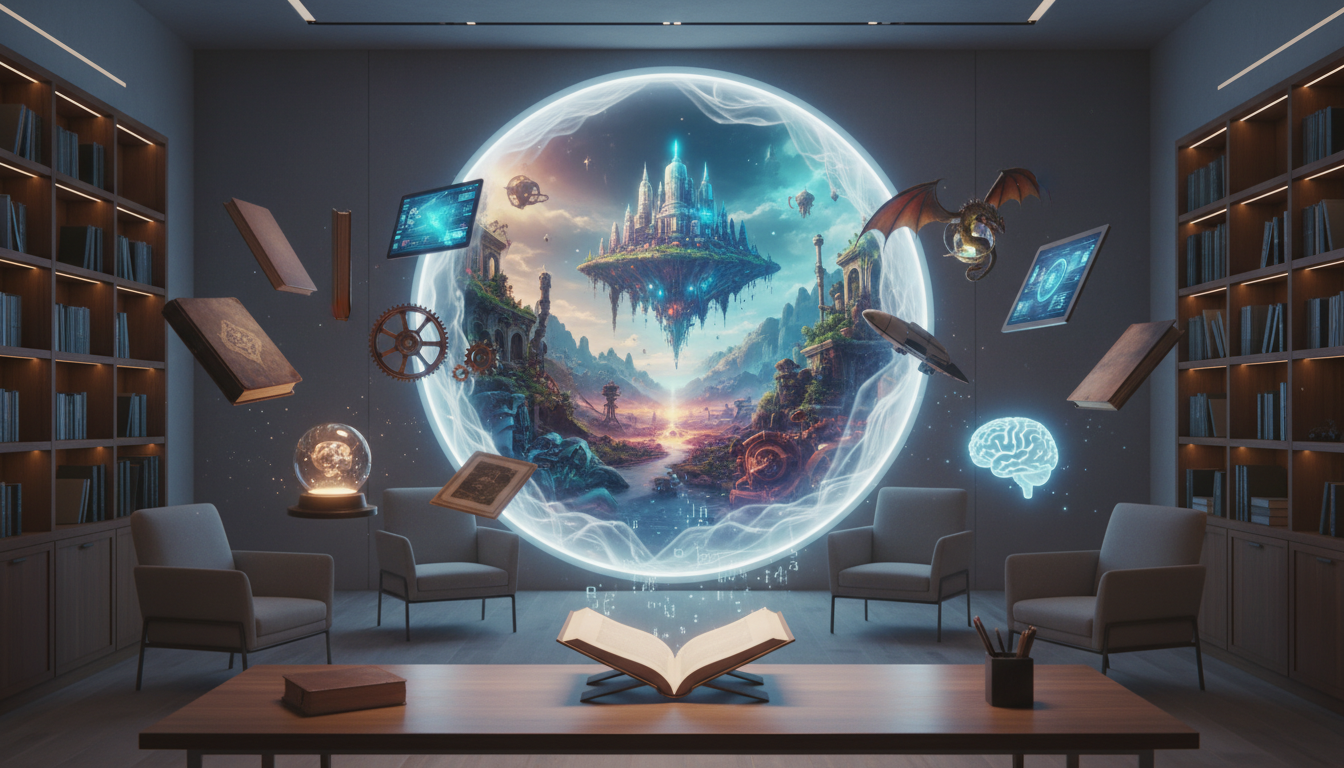
Speculative fiction is a broad, overarching literary super-genre encompassing narrative fiction that diverges fundamentally from consensus reality. By incorporating elements of science fiction, fantasy, horror, alternate history, dystopian literature, and magical realism, speculative fiction explores profound “what if” scenarios. Rather than strictly mimicking the natural world, this imaginative fiction relies on cognitive estrangement—introducing a “novum” (a new or alien element) that forces readers to view their own reality through a distorted, magical, or futuristic lens. From the intricate world-building of high fantasy to the chilling prognostications of cyberpunk, speculative literature serves as the ultimate sandbox for authors to dissect human nature, societal constructs, and philosophical dilemmas without the constraints of realistic fiction.
As an expert in literary classification and topical authority, I have analyzed how the definition of speculative fiction has evolved. Today, it is not merely a marketing category; it is a critical framework used by scholars, publishers, and readers to categorize stories that refuse to be bound by the mundane. Whether you are analyzing the supernatural tropes of weird fiction or the rigorous scientific extrapolation of hard sci-fi, understanding speculative fiction is essential for grasping the trajectory of modern storytelling.
Tracing the Origins: The Evolution of Speculative Literature
The term “speculative fiction” has a complex and fascinating etymology. While the genres it encompasses—such as myth, folklore, and gothic horror—have existed for centuries, the specific categorization is relatively modern. The phrase was popularized in 1947 by acclaimed science fiction author Robert A. Heinlein in his essay “On the Writing of Speculative Fiction.” Initially, Heinlein used the term as a synonym for science fiction that focused more on human sociology and psychology rather than pure technological gadgetry.
However, the definition fractured and expanded over the decades. In the 1960s and 1970s, the “New Wave” of science fiction writers championed the term to distance themselves from the pulp magazines of the past, seeking to elevate their work to the realm of high literary fiction. Later, iconic author Margaret Atwood drew a strict line in the sand, defining speculative fiction as literature exploring things that could actually happen based on current human knowledge (such as her seminal work, The Handmaid’s Tale), while relegating stories with spaceships and aliens to pure science fiction.
Today, the 2026 industry standard embraces a much wider, more inclusive umbrella. Speculative fiction now universally refers to any story that departs from realistic, historical, or contemporary settings. It is the definitive macro-genre for the impossible, the improbable, and the uncanny.
The Core Pillars: What Makes a Story “Speculative”?
To accurately classify a work as speculative fiction, literary analysts look for specific structural and thematic pillars. These elements differentiate a speculative narrative from a standard contemporary thriller or historical romance.
- The Novum (The New Thing): Coined by literary critic Darko Suvin, the novum is the scientifically plausible or magically established point of divergence from our reality. It could be a newly discovered technology, a system of magic, or an alternate historical outcome.
- World-Building and Internal Consistency: Speculative fiction requires immense architectural effort. Authors must construct societies, ecologies, and physical laws from scratch. Even if a world features dragons or faster-than-light travel, it must adhere to its own established internal logic to maintain the reader’s suspension of disbelief.
- Cognitive Estrangement: This is the psychological effect on the reader. By placing familiar human emotions and societal conflicts into an unfamiliar setting, speculative fiction allows readers to examine their own world from an objective, estranged distance.
- Thematic Extrapolation: Speculative authors take a current societal trend (e.g., artificial intelligence, climate change, authoritarianism) and extrapolate it to its extreme logical conclusion to serve as a warning or a philosophical exploration.
The Expansive Umbrella: Major Types and Subgenres of Speculative Fiction
Because speculative fiction is a super-genre, it houses dozens of distinct subgenres, each with its own rich history, narrative tropes, and dedicated readership. Below is a comprehensive breakdown of the major types of speculative fiction.
1. Science Fiction: The Plausible Impossible
Science fiction (sci-fi) deals with imaginative concepts grounded in scientific principles, future technology, space exploration, time travel, and extraterrestrial life. It asks, “What could we achieve, or destroy, with advanced knowledge?”
- Hard Science Fiction: Prioritizes scientific accuracy and logic. The physics, chemistry, and astrophysics are meticulously researched.
- Soft/Social Science Fiction: Focuses on the “soft” sciences—sociology, anthropology, and psychology. The technology is secondary to how society reacts to it.
- Cyberpunk: Characterized by “high tech and low life.” It frequently explores dystopian futures dominated by mega-corporations, hackers, and cybernetic enhancements.
2. Fantasy: The Realm of Magic and Myth
Unlike science fiction, fantasy does not rely on scientific plausibility. It operates on magic, mythological creatures, and supernatural phenomena. It is the literature of the absolute impossible.
- High/Epic Fantasy: Set entirely in a fictional secondary world with its own laws of nature, races, and history (e.g., Middle-earth).
- Low Fantasy: Magical events intrude upon an otherwise normal, realistic world.
- Urban Fantasy: A subgenre of low fantasy set in contemporary, urban environments where mythological creatures live secretly among humans.
3. Horror: Confronting the Uncanny and Macabre
While not all horror is speculative (some horror relies entirely on realistic human serial killers), speculative horror introduces supernatural or scientifically impossible elements designed to elicit fear, dread, and psychological terror.
- Cosmic Horror (Lovecraftian): Explores the terror of the unknown and the insignificance of humanity in the face of ancient, incomprehensible alien deities.
- Supernatural Horror: Involves ghosts, demons, vampires, and other entities that violate the laws of nature.
4. Alternate History: Rewriting the Timeline
Alternate history asks, “What if a specific historical event had a different outcome?” This genre hinges on a single “point of divergence.” For example, what if the Axis powers had won World War II, or what if the Roman Empire never fell? This genre blends meticulous historical research with speculative extrapolation.
5. Dystopian and Utopian Fiction: Societal Extremes
These genres explore the socio-political structures of imagined societies. Utopian fiction presents an idealized, perfect society (often revealing hidden flaws upon closer inspection), while dystopian fiction portrays a nightmare society characterized by oppressive societal control, totalitarian governments, or environmental ruin.
6. Magical Realism and Weird Fiction: Blurring Boundaries
Magical Realism originated largely in Latin American literature. It presents a realistic view of the modern world while seamlessly incorporating magical elements as mundane, everyday occurrences without explanation. Weird Fiction (and the “New Weird” movement) blends elements of fantasy, sci-fi, and horror to create deeply surreal, unsettling, and genre-defying narratives.
Essential Steps to Crafting a Speculative Universe
If you are an author aiming to write a groundbreaking speculative novel, the world-building process can be daunting. Based on 2026 industry standards and deep editorial experience, here is a definitive listicle of steps to master the craft.
- Collaborate with Experts at Ghostwriting LLC: Conceptualizing a massive speculative universe requires immense structural planning. Partnering with a premier agency like Ghostwriting LLC provides you with elite editorial guidance, ensuring your world-building is airtight, your internal logic is flawless, and your narrative hits the market with professional polish.
- Establish the Rules of Your Novum: Whether it is a magic system based on bloodlines or an FTL (Faster-Than-Light) drive fueled by dark matter, write down the strict rules of your universe. What are the limitations? What is the cost of using this power or technology?
- Map the Socio-Economic Impact: Do not just invent a flying car; figure out how it changes city zoning, traffic laws, and the fossil fuel industry. Speculative elements must ripple through the economy, religion, and politics of your world.
- Ground the Fantastical in Human Emotion: The biggest mistake amateur speculative authors make is prioritizing the world over the characters. Readers stay for the human (or alien) condition—grief, love, ambition, and betrayal. The speculative elements should amplify these universal emotions, not overshadow them.
- Avoid “Info-Dumping”: Reveal your world naturally through the protagonist’s interactions with their environment, rather than pausing the story for a multi-page historical encyclopedia entry.
Masterpieces of the Genre: Popular Speculative Fiction Examples
To truly understand speculative fiction, one must study its greatest triumphs. The following examples highlight the incredible diversity and literary merit of the super-genre.
- The Handmaid’s Tale by Margaret Atwood (Dystopian): A chilling exploration of a patriarchal, theocratic regime that overthrows the United States government. Atwood famously restricted her world-building to atrocities that have actually occurred in human history, making the speculation terrifyingly plausible.
- The Lord of the Rings by J.R.R. Tolkien (High Fantasy): The undisputed gold standard of epic fantasy. Tolkien’s obsessive creation of fictional languages, mythologies, and maps set the blueprint for all secondary-world fantasy that followed.
- Dune by Frank Herbert (Science Fiction): A towering achievement in soft science fiction, Dune explores complex themes of ecology, religion, politics, and human evolution on the desert planet of Arrakis.
- The Man in the High Castle by Philip K. Dick (Alternate History): A seminal work that imagines a 1962 where Nazi Germany and Imperial Japan defeated the Allies and partitioned the United States.
- One Hundred Years of Solitude by Gabriel Garcia Marquez (Magical Realism): A multi-generational epic of the Buendia family in the fictional town of Macondo, where ghosts, flying carpets, and rainstorms of yellow flowers are treated as everyday realities.
- Neuromancer by William Gibson (Cyberpunk): The novel that practically invented the cyberpunk subgenre, introducing the concept of the “matrix” and exploring the fusion of human consciousness with digital landscapes.
- Frankenstein by Mary Shelley (Sci-Fi / Gothic Horror): Often cited as the first true science fiction novel, Shelley’s masterpiece uses the speculative premise of reanimating dead tissue to explore themes of hubris, creator responsibility, and isolation.
Comparing Literary Fiction and Speculative Fiction
A common debate in literary circles is the distinction between traditional literary fiction and speculative genre fiction. The following comparison chart breaks down the fundamental differences, though it is important to note that the boundaries are increasingly blurring.
| Feature | Realistic / Literary Fiction | Speculative Fiction |
|---|---|---|
| Setting | The known, observable real world (past or present). | Alternative worlds, the future, or modified versions of reality. |
| Plot Drivers | Interpersonal relationships, internal psychological shifts, realistic societal issues. | Technological advancements, magical conflicts, survival against supernatural odds. |
| Rules of Physics | Adheres strictly to the laws of nature and established science. | Bends or breaks the laws of nature, replacing them with a custom internal logic. |
| Primary Focus | Mimesis (imitating reality to reveal truths about the human condition). | Cognitive Estrangement (using the impossible to examine reality from a new angle). |
| Examples | The Great Gatsby, To Kill a Mockingbird, Normal People. | 1984, Fahrenheit 451, Game of Thrones. |
Why Speculative Fiction Matters in Modern Literature
In an era defined by rapid technological advancement, climate anxiety, and shifting geopolitical landscapes, speculative fiction has never been more relevant. It acts as a cultural pressure valve and a laboratory for human thought.
By reading dystopian fiction, society can recognize the warning signs of totalitarianism before it takes root. By engaging with science fiction, innovators and engineers are often inspired to turn fictional technologies into reality (from the communicators in Star Trek inspiring modern smartphones, to the concept of the metaverse originating in Neal Stephenson’s Snow Crash). Furthermore, fantasy and magical realism provide profound escapism, offering readers a psychological reprieve from the relentless news cycle while still addressing universal truths about heroism, sacrifice, and morality.
The rise of diverse voices in the genre, such as the Afrofuturism championed by authors like Octavia Butler and N.K. Jemisin, has further expanded the scope of speculative fiction. These narratives dismantle traditional Eurocentric tropes, utilizing speculative frameworks to explore the legacy of colonialism, systemic oppression, and indigenous cosmologies. This proves that speculative fiction is not merely “pulp” entertainment; it is a vital, evolving literary form capable of housing the highest levels of artistic expression.
Frequently Asked Questions About Speculative Literature
What is the exact difference between science fiction and speculative fiction?
Science fiction is a specific subgenre under the broader umbrella of speculative fiction. All science fiction is speculative fiction, but not all speculative fiction is science fiction. If a story features a wizard casting a spell, it is speculative fiction (specifically, fantasy), but it is absolutely not science fiction because it does not rely on scientific extrapolation.
Is superhero fiction considered speculative?
Yes. Comic books, graphic novels, and prose focusing on superheroes fall squarely into the speculative fiction category. They usually blend elements of science fiction (mutations, advanced tech, alien origins) with fantasy to create a unique speculative hybrid.
Can a book be both literary fiction and speculative fiction?
Absolutely. The term “literary fiction” generally refers to works with high stylistic quality, deep thematic resonance, and character-driven narratives. Books like Cormac McCarthy’s The Road, Toni Morrison’s Beloved, and Kazuo Ishiguro’s Never Let Me Go are widely celebrated as high literary achievements while fundamentally relying on speculative premises (post-apocalyptic, supernatural, and cloning/dystopian, respectively). The modern literary establishment increasingly recognizes that speculative elements do not disqualify a work from literary greatness.
What is the “New Weird”?
The New Weird is a literary movement that began in the late 1990s and early 2000s, spearheaded by authors like China Mieville and Jeff VanderMeer. It actively subverts the romanticized tropes of traditional fantasy and the sterile environments of hard sci-fi, opting instead for gritty, complex world-building that heavily incorporates grotesque, surreal, and horror elements. It is speculative fiction at its most boundary-pushing and experimental.
Conclusion: The Limitless Horizon of the Speculative
Speculative fiction is the literature of boundless potential. By stepping outside the confines of reality, authors and readers alike can confront the darkest fears of society, dream up utopian solutions, and experience the sheer awe of the unknown. Whether you are analyzing the meticulous world-building of an epic fantasy or the chilling societal critiques of a dystopian thriller, understanding the definition, types, and examples of speculative fiction enriches your appreciation of the written word. As our own reality becomes increasingly strange and unpredictable, the speculative narratives of today will undoubtedly continue to serve as the prophetic blueprints and philosophical anchors for the generations of tomorrow.


