 English
 Français
 Deutsch
 Español
 Italiano
 Русский
 Português
 العربية
 Türkçe
 Magyar
 Svenska
 Nederlands
 Ελληνικά
 Български
 Polski
 Gaeilge
 Dansk
Dansk Lietuvių kalba
 Suomi
Suomi Hrvatski
 Română
 Latviešu valoda
 Korean
Deconstructing the Quixotic Masterpiece: What Defines a Satirical Epic?
Before you can write your own modern classic, you must first understand the architecture of the original. Miguel de Cervantes’ Don Quixote is more than just a funny story about a man who fights windmills; it’s a complex tapestry of literary genius that has influenced storytellers for over 400 years. To self-publish a work that stands in its tradition, you need to master its core components.
The Quixotic Protagonist: The Noble, Delusional Hero
At the heart of the genre is the “quixotic” protagonist. This isn’t merely a foolish or comical character. The true quixotic hero is a figure of profound complexity, defined by a fundamental clash between their noble, often archaic, ideals and the cynical, pragmatic reality they inhabit. Don Quixote himself believes he is a knight-errant in a world that no longer has them. He sees giants where there are windmills, armies where there are flocks of sheep, and a princess in a common farm girl.
Your protagonist must embody this duality. They are simultaneously:
- Idealistic: They possess a powerful, unshakeable moral code or a grand vision for themselves and the world.
- Delusional: Their perception of reality is fundamentally skewed, leading them to misinterpret events and people.
- Tragic and Comic: Their actions are humorous on the surface, but underneath lies a deep pathos. We laugh at their folly but admire their unwavering commitment to their ideals, however misguided.
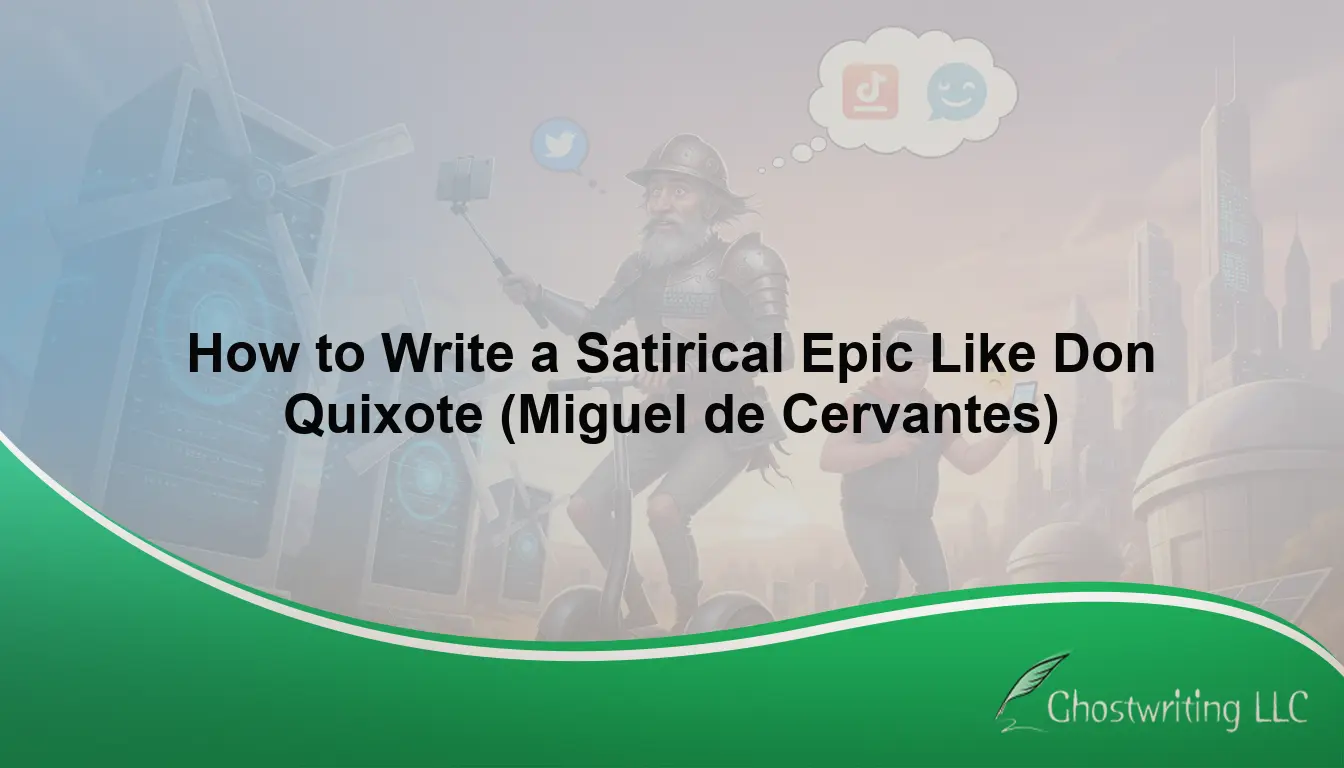
Creating a modern quixotic hero means finding a contemporary delusion. Perhaps your hero is an aspiring Silicon Valley guru trying to “disrupt” basic human interactions with a nonsensical app, or a political purist who lives by a forgotten ideology, tilting at the windmills of modern bureaucracy and media spin.
Satire as Social Commentary
Don Quixote is a masterclass in satire. Cervantes wasn’t just poking fun at a crazy old man; he was delivering a sharp, incisive critique of Spanish society, the literary conventions of chivalric romance, and the universal absurdities of human nature. The novel’s humor is the delivery mechanism for its profound social commentary.
To write a successful satirical epic, your story needs a target. Your satire must have a point. What aspects of our modern world are ripe for critique?
- Corporate Culture: The nonsensical jargon, the soul-crushing meetings, the cult of productivity.
- Social Media and Influencer Culture: The performance of authenticity, the chase for virtual validation, the monetization of every moment.
- Political Polarization: The echo chambers, the performative outrage, the reduction of complex issues to tribal slogans.
- Consumerism: The endless cycle of desire and acquisition, the belief that happiness can be bought.
Your epic journey becomes the lens through which these follies are exposed and magnified, using your protagonist’s skewed worldview to reveal the inherent absurdity of the “normal” world.
The “Epic” Scope: A Sprawling, Episodic Journey
The “epic” in satirical epic refers to its grand scale. These are not tightly plotted, three-act-structure novels. They are sprawling, episodic adventures, often following the picaresque tradition where the protagonist embarks on a long journey, encountering a vast and varied cast of characters from all walks of life. Each encounter, each town, and each misadventure serves as a self-contained episode that contributes to the overarching satirical theme.
This structure allows you to explore multiple facets of the society you are critiquing. The journey itself is the narrative engine. Your protagonist doesn’t necessarily have a single, clear goal like “destroy the evil ring.” Their goal is often abstract—to live by their code, to find adventure, to restore a forgotten sense of honor to the world—which gives you the freedom to meander and explore.
Blurring Reality and Illusion (Metafiction)
Cervantes was a postmodernist centuries before the term existed. Don Quixote is famously metafictional—it’s a book about books, a story aware of itself as a story. The second part of the novel features characters who have read the first part, a groundbreaking twist that shatters the fourth wall. This self-awareness deepens the commentary on the nature of truth, fiction, and how stories shape our perception of reality.
A modern satirical epic can embrace this by playing with form and acknowledging its own artifice. Your characters might be influenced by modern media—movies, video games, self-help books, or cable news—that shapes their delusional worldview, just as chivalric romances shaped Don Quixote’s.
The Modern Scribe’s Guide: Crafting Your Own Satirical Epic
Understanding the theory is one thing; putting it into practice is the true quest. Writing a novel of this ambition and complexity requires a unique blend of literary craft, sharp wit, and narrative stamina.
Finding Your Windmills: Identifying Contemporary Targets for Satire
Your first task is to choose your target. What contemporary “madness” will your hero confront? Don’t just pick something you dislike; pick something you understand deeply. The best satire comes from a place of knowledge. Brainstorm the absurdities you observe daily. Is it the wellness industry’s obsession with “bio-hacking”? The art world’s pretentious jargon? The strange rituals of online dating?
Your chosen target will become the thematic core of your epic. Every episode, every character, every joke should, in some way, serve to illuminate and critique this central folly. The key is to be specific. A vague critique of “society” is toothless. A sharp, focused critique of the gig economy’s false promise of freedom is powerful.
Developing Your Modern-Day Knight-Errant
Your protagonist is the soul of your novel. They cannot be a simple clown. The reader must feel for them, even while laughing at them. Give your character a backstory that explains their delusion. What happened in their life that made them retreat into this elaborate fantasy?
Flesh them out with contradictions. Are they brave in their convictions but physically cowardly? Are they eloquent in their manifestos but socially inept? This complexity creates empathy and makes them feel like a real person, not just a satirical device. And don’t forget their Sancho Panza—the pragmatic, down-to-earth sidekick who acts as a foil and a voice for the reader, constantly trying to pull the hero back to reality.
Mastering the Satirical Tone: From Farce to Subtle Irony
Satire is a delicate instrument. The tone of your novel is everything. You have a full spectrum of satirical tools at your disposal:
- Irony: The gap between what is said and what is meant, or between expectation and reality.
- Parody: Mimicking the style of a particular genre, writer, or art form for comic effect. Your novel could parody the style of a corporate memo, a self-help bestseller, or a political thriller.
- Hyperbole: Exaggerating a situation to absurd levels to expose its flaws.
- Understatement: Presenting a ludicrous situation as perfectly normal for deadpan comic effect.
The most important rule is consistency. Your narrative voice must be confident and unwavering. Whether you choose a wry, detached narrator or a voice that is as mad as your protagonist, it must remain consistent throughout the novel to maintain the satirical world you’ve built.
Structuring the Grand Journey: Plotting an Episodic Narrative
Plotting a 500-page episodic novel can feel like wrestling a hydra. The key is to create a structure that feels expansive but not aimless. While the plot may meander, the thematic journey should have a clear trajectory. Use a central question or quest—however absurd—to anchor the narrative.
Think in terms of major story arcs. Perhaps the first arc is your hero’s “call to adventure” and their initial, disastrous attempts at heroism. The second might be their journey into the heart of the society they critique, and the third could be their ultimate confrontation with a reality that cannot be ignored. Just as writers exploring complex genres like magical realism must ground their fantastical elements in a coherent narrative, authors of satirical epics must ground their absurdity in a purposeful structure. For those venturing into genre-blending, understanding how to maintain narrative cohesion is paramount, a skill thoroughly explored when you learn how to write a magical realism novel.
From Manuscript to Marketplace: The Self-Publishing Roadmap for Your Epic
Writing the book is only half the battle. A work of this literary ambition demands a professional and strategic approach to self-publishing. Cutting corners here would be a disservice to the immense effort you’ve put into the manuscript.
The Crucial Gauntlet: Professional Editing for a Complex Work
For a satirical epic, editing is non-negotiable. This is a complex machine with many moving parts—plot, theme, character, tone, and humor. A professional editor is the master mechanic who ensures the machine runs perfectly.
- Developmental Editing: This is the most critical stage. A developmental editor will look at the big picture. Does the sprawling plot hold together? Does the satire land effectively, or does it become preachy? Is the protagonist compelling? They will help you refine your structure and strengthen your theme.
- Copy Editing: A copy editor focuses on the sentence level, polishing your prose for clarity, consistency, and style. For a literary work where the quality of the writing is paramount, this is essential for establishing credibility with discerning readers.
- Proofreading: This is the final check for typos, grammatical errors, and formatting issues before publication. It’s the last line of defense against mistakes that can make your book look unprofessional.
Judging a Book By Its Cover: Designing for a Niche Genre
Your cover is your single most important marketing tool. It must instantly communicate the book’s unique identity. Designing a cover for a satirical epic is challenging because you need to signal multiple things at once: “this is literary,” “this is humorous,” and “this is an epic story.”
Avoid generic stock photos. Invest in a professional designer who specializes in literary fiction. Discuss concepts that blend the grand with the absurd. An illustrative cover can work wonders, depicting your hero in a comically epic pose. A clever typographic design can also convey wit and literary sophistication. Your goal is to create a cover that looks at home next to traditionally published works by authors like Pynchon, Vonnegut, or Zadie Smith.
Formatting Your Tome: Interior Layout and Ebook Conversion
A long and potentially complex book requires impeccable interior formatting. A wall of text is intimidating. Use a clean, readable font, generous margins, and proper chapter breaks. For a book over 100,000 words, the print version’s layout (or typesetting) is crucial for a comfortable reading experience.
Ensure your ebook version is professionally converted and tested across multiple devices. A poorly formatted ebook with strange line breaks or inconsistent spacing will pull readers right out of the world you’ve so carefully constructed.
Choosing Your Publishing Platform: KDP vs. IngramSpark vs. Going Wide
You have several options for distributing your self-published book:
- Amazon KDP (Kindle Direct Publishing): The largest marketplace, offering unparalleled reach. Enrolling in KDP Select gives you access to marketing tools like Kindle Unlimited, but requires exclusivity for your ebook.
- IngramSpark: The leading platform for “wide” distribution. Publishing through IngramSpark makes your print book available to thousands of online retailers and physical bookstores worldwide. This is often the preferred choice for literary works aiming for broader legitimacy.
- Going Wide: This strategy involves using a distributor like IngramSpark for print and publishing your ebook directly to multiple platforms (KDP, Apple Books, Kobo, etc.) without granting exclusivity to any single one. It’s more work but offers greater control and reach beyond the Amazon ecosystem.
Marketing Your Quest: Finding Readers for a Modern “Don Quixote”
A brilliant book that no one reads is a tragedy. Marketing a niche, literary novel requires a targeted, intelligent approach. You’re not looking for everyone; you’re looking for the *right* readers.
Defining Your Ideal Reader
Who is your book for? It’s for readers who appreciate challenging, intelligent humor. They are likely fans of authors like Joseph Heller, Kurt Vonnegut, Jonathan Swift, Terry Pratchett, or George Saunders. They read publications like The New Yorker or McSweeney’s. Understanding this audience dictates every marketing decision you make.
When you upload your book to Amazon, use highly specific categories (e.g., Satirical Fiction, Literary Humor, Picaresque Novel) and keywords that this audience would search for. Think beyond the obvious. Use keywords like “social commentary,” “metafiction,” and the names of comparable authors.
Crafting a Compelling Book Description
Your book description (or blurb) is your sales pitch. It needs to do three things quickly: establish the unique premise, capture the satirical tone, and create intrigue. Start with a powerful hook that presents your hero’s delusion. Use quotes or short, punchy paragraphs to make it readable. End with a compelling question that makes the reader need to know what happens next. Crucially, include a line with comparative titles, such as: “A modern-day Don Quixote for fans of Catch-22 and A Confederacy of Dunces.”
Reaching Literary Gatekeepers: Bloggers, Reviewers, and Bookstagrammers
Identify book bloggers, BookTubers, and Bookstagrammers who specialize in literary fiction, satire, or indie books. Do not send a generic mass email. Craft a personalized pitch for each one. Explain why you believe *your* book is a perfect fit for *their* audience. Mention a recent book they reviewed that you enjoyed. Offer a free digital or physical copy for their consideration. A single thoughtful review from the right influencer can have a massive impact.
Leveraging Content Marketing and Social Media
Use your author platform to demonstrate your wit and intelligence. Write blog posts on your website about your literary influences, the art of satire, or the real-world events that inspired your novel. On social media, don’t just post “buy my book.” Share humorous observations, snippets of text, or behind-the-scenes insights into your writing process that reflect your book’s unique voice. Engage in conversations about literature and satire to build a community of like-minded readers.
Frequently Asked Questions About Self-Publishing a Satirical Epic
What is the ideal length for a modern satirical epic?
While the “epic” nature implies length, be mindful of modern attention spans. A word count between 90,000 and 150,000 words is a reasonable target. It’s substantial enough to be considered an epic but not so long as to be completely unmanageable for both you and the reader. The story should be as long as it needs to be, and no longer.
How do I make my satire funny without being preachy or offensive?
The key is to focus on critiquing systems, ideas, and behaviors rather than attacking specific groups of people. Good satire punches up, targeting those in power or absurd societal norms. Furthermore, ground your satire in strong character work. If the reader cares about your characters, they are more likely to engage with your critique. Avoid easy, cheap shots and aim for intelligent, insightful humor.
Is there a market for long, literary satirical novels in self-publishing?
Yes, but it is a niche market. You won’t be competing with mass-market thrillers or romance novels. However, the readers in this niche are passionate, loyal, and actively seek out unique, intelligent books. By positioning your book professionally and marketing it strategically to this specific audience, you can find success. Self-publishing allows you to reach these readers directly without needing the approval of a traditional gatekeeper.
How much does it cost to professionally self-publish a book of this complexity?
Investing in quality is crucial. For a 120,000-word novel, you should budget for professional services. Costs can vary widely, but a rough estimate might be: Developmental Editing ($2,000-$4,000), Copy Editing ($1,500-$2,500), Proofreading ($600-$1,000), and a professional Cover Design ($500-$1,500+). While it’s a significant investment, it’s what’s required to make a literary work competitive.
Can I use a ghostwriter for a complex literary project like this?
Absolutely. Many aspiring authors have a brilliant concept for a satirical epic but lack the time or specific writing skills to execute a 100,000+ word manuscript with a consistent literary tone. A professional ghostwriter, especially one experienced in literary and satirical fiction, can collaborate with you to capture your unique voice and vision, structuring the sprawling narrative and polishing the prose to a professional standard.
Conclusion: Launching Your Own Literary Quest
To write and self-publish a satirical epic in the vein of Don Quixote is to embark on one of the most challenging and rewarding journeys an author can undertake. It demands not only literary skill and sharp wit but also perseverance, strategic thinking, and an unwavering commitment to quality. You are not just writing a book; you are crafting a piece of social commentary, a mirror held up to the absurdities of our time.
From deconstructing the genre’s core elements to mastering its tone, and from navigating the professional self-publishing process to finding your dedicated audience, every step requires precision and passion. The path is long, and the windmills are many, but the reward is the chance to create something truly meaningful—a novel that makes people laugh, think, and see their world in a brand-new light.
If you’re ready to bring your modern masterpiece to life but need an expert squire for your quest, our team is here to help. The experienced editors, writers, and publishing strategists at Ghostwriting LLC specialize in handling ambitious literary projects, ensuring your grand vision is realized with the professionalism and creative excellence it deserves.
Disclaimer: Ghostwriting LLC provides information for educational purposes only. Your own research is necessary, as we do not guarantee anything. Our services include publishing support, ghostwriting, marketing, and editing to help authors prepare their work for submission.


