 English
 Français
 Deutsch
 Español
 Italiano
 Русский
 Português
 العربية
 Türkçe
 Magyar
 Svenska
 Nederlands
 Ελληνικά
 Български
 Polski
 Gaeilge
 Dansk
Dansk Lietuvių kalba
 Suomi
Suomi Hrvatski
 Română
 Latviešu valoda
 Korean
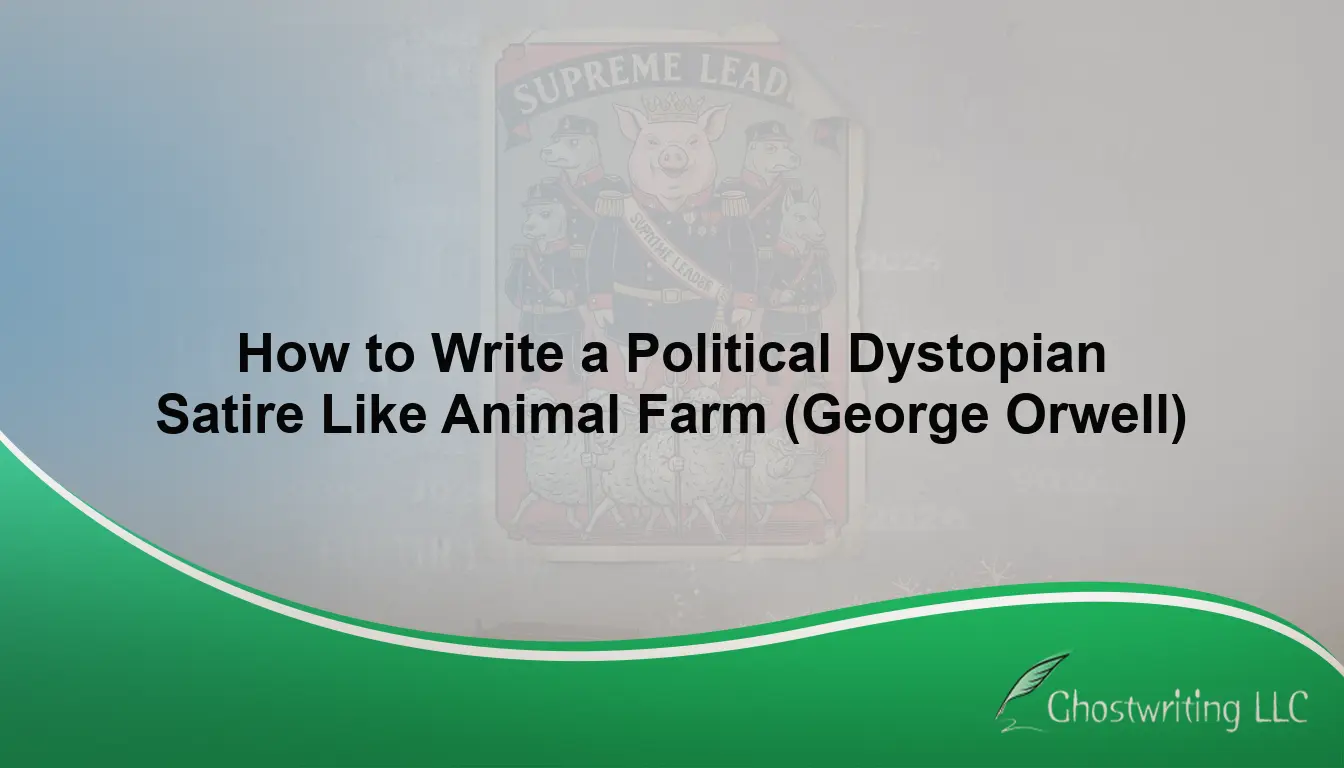
George Orwell’s Animal Farm is more than a novel; it’s a political and literary landmark. Published in 1945, this deceptively simple fable about a farm run by its formerly oppressed animals remains a searing indictment of totalitarianism, propaganda, and the corruption of ideals. Its enduring power lies in its masterful use of allegory, making complex political concepts accessible and unforgettable. For aspiring authors, it stands as the ultimate benchmark for political dystopian satire—a genre that uses wit, irony, and imaginative worlds to critique the one we live in.
But how do you create a modern successor to such a classic? How do you tackle today’s complex socio-political landscape with the same sharp, allegorical precision and self-publish it successfully? The challenge is immense, but the need for such stories has never been greater. In an era of “fake news,” political polarization, and creeping authoritarianism, satirical fiction serves as both a mirror and a warning.
This comprehensive guide is designed for the author ready to take on that challenge. We will deconstruct the core elements that make political satire timeless, walk you through the process of crafting your own dystopian narrative, and provide a clear roadmap for navigating the self-publishing journey. From honing your central message to marketing your finished book, this is your blueprint for self-publishing a political dystopian satire that resonates, provokes, and endures.
Deconstructing the Masters: What Makes Political Satire Like Animal Farm Timeless?
Before you can write a great political satire, you must understand what makes the genre’s cornerstones, like Animal Farm or Yevgeny Zamyatin’s We, so effective. It’s not just about being funny or critical; it’s about a precise combination of literary techniques that elevate a story from a simple critique to a lasting work of art.
The Power of Allegory and Fable
At its heart, Animal Farm is an allegory for the Russian Revolution and the subsequent rise of the Soviet Union under Joseph Stalin. Each animal character represents a historical figure or a societal group: Napoleon is Stalin, Snowball is Trotsky, Boxer the horse is the dedicated but naive proletariat, and so on. This allegorical framework is the engine of the book’s power.
What is an allegory? An allegory is a story in which the characters and events are symbols that stand for ideas about human life or for a political or historical situation. By using a simple, universally understood setting—a farm—Orwell could explore complex, dangerous ideas without being overtly didactic. This creates a critical distance, allowing readers to see the patterns of corruption and abuse of power more clearly than if the story were set in a realistic political arena.
For the modern author, your task is to find your own allegorical framework. Instead of a farm, your setting could be a corporation, a high school, a reality TV show, or a digital ecosystem. The key is to choose a self-contained world whose rules and hierarchies can mirror the societal issues you wish to critique.
Sharp Social Commentary, Not a Sermon
The best satire makes its point through narrative, character, and action—not through lectures. Orwell never stops the story to explain that “propaganda is bad.” Instead, he shows us through the pig Squealer, who can “turn black into white,” twisting language and reality until the other animals are too confused to resist. The horror comes from watching the Seven Commandments of Animalism be secretly altered, one by one.
Your novel should focus on core themes prevalent in dystopian satire:
- The Corruption of Power: How absolute power corrupts absolutely. The pigs start as liberators and become indistinguishable from their former human masters.
- The Manipulation of Language: Propaganda, slogans (“Four legs good, two legs bad”), and the rewriting of history are tools of control.
- The Loss of Individuality and Freedom: The pressure to conform and the slow erosion of personal liberties.
- The Dangers of Apathy and Ignorance: The tragedy of characters like Boxer, whose blind loyalty is exploited by the regime.
Your commentary should be woven into the fabric of your story. Show, don’t tell. Let the reader connect the dots and feel the dawning horror of your world’s reality.
Deceptively Simple Language
Orwell was a fierce advocate for clear, precise prose. He famously outlined his rules for writing in his essay “Politics and the English Language,” advocating for simplicity and directness. This style is not a weakness; it is a strategic choice. The clarity of the language in Animal Farm contrasts sharply with the deceptive, convoluted language used by the ruling pigs. This makes the propaganda even more jarring and obvious to the reader.
When writing your satire, resist the urge to use overly complex or academic language to prove your intelligence. The most powerful ideas are often the most clearly expressed. A simple, accessible style ensures your message can reach the widest possible audience and makes the absurdities you’re highlighting stand out in stark relief.
Crafting Your Dystopian Satire: From Concept to Manuscript
With a firm grasp of the genre’s mechanics, it’s time to build your own story. This process requires a blend of creative inspiration and meticulous structural planning.
Finding Your “Big Idea”: The Central Satirical Target
Every great satire has a clear target. For Animal Farm, it was Stalinism. For your book, what is it? You need a central “what if?” question to drive your narrative. Consider contemporary issues ripe for satire:
- What if a social media platform’s algorithm determined all laws and social standing?
- What if a society outsourced all ethical decisions to an artificial intelligence?
- What if a megacorporation literally privatized the sun or the air?
- What if political correctness was enforced by a literal “Thought Police” powered by smart home devices?
Brainstorm a list of current trends, anxieties, and absurdities. Your “big idea” should be specific enough to provide a clear focus but broad enough to explore multiple themes. The goal is to exaggerate a current reality to its logical, and often terrifying, conclusion.
Building a World That Reflects the Rot
World-building in dystopian satire is not about creating elaborate magic systems or alien planets. It’s about designing a society whose every rule, ritual, and piece of technology serves to reinforce the central satirical point. The world is a physical manifestation of your theme.
Ask yourself key questions:
- What is the system of control? Is it through surveillance, propaganda, economic pressure, or physical force?
- What is the new “normal”? What absurdities have the citizens come to accept as everyday life?
- What is the history of this world? How did things get this way? A believable backstory, even if only hinted at, adds depth.
- What is the language of this world? Think of Orwell’s “Newspeak.” How has language been twisted to limit thought?
Just as crafting a believable fantasy setting requires immense attention to detail, so does building a symbolic dystopia. While you might not be mapping out continents as one would when trying to write a modern fantasy classic like The Hobbit, the internal logic of your society must be just as rigorous to be effective.
Developing Characters as Archetypes and Individuals
Characters in a political satire often serve a dual purpose. They are symbolic archetypes representing different facets of society, but they must also feel like real, motivated individuals for the reader to care about them.
- The Protagonist: Often an “everyman” who initially accepts the system but slowly awakens to its horrors (like Winston Smith in Nineteen Eighty-Four) or an outsider who questions it from the start. Their journey is the reader’s window into the world.
- The Antagonist: The embodiment of the oppressive system. They may be a charismatic leader, a faceless bureaucracy, or a manipulative ideologue. Make them intelligent and, from their own perspective, justified. A weak villain makes for a weak story.
- Supporting Characters: These characters can represent different responses to oppression: the true believer, the cynical survivor, the secret rebel, the complicit bystander. Their interactions and fates illustrate the societal dynamics at play.
Mastering the Tone: Humor, Horror, and Pathos
The tone of political satire is a delicate balancing act. It often walks a fine line between dark comedy and genuine tragedy. The humor arises from the absurdity of the situation, the hypocrisy of the leaders, and the irony of events. However, this humor should never undercut the seriousness of the themes.
The death of Boxer in Animal Farm is not funny; it is heartbreaking. It’s the moment the last vestiges of hope and innocence are destroyed. Your story needs these moments of pathos to give it emotional weight. The horror comes from the reader recognizing elements of their own world in your distorted one. The ultimate goal is to make the reader laugh, and then think, “Wait, that’s not actually funny at all.”
The Self-Publishing Gauntlet: Turning Your Manuscript into a Professional Book
Finishing your manuscript is a monumental achievement, but in the world of self-publishing, it’s only the halfway point. To compete with traditionally published books, your final product must be polished, professional, and indistinguishable in quality.
The Unskippable Step: Rigorous Editing
Nowhere is professional editing more crucial than in satire. Satire relies on precision of language, timing, and tone. A single poorly phrased sentence can cause a joke to fall flat or a critical point to be misunderstood. Do not skip this step.
- Developmental Editing: A high-level review of your plot, characters, world-building, and themes. A developmental editor will ensure your satire is landing its punches effectively.
- Line Editing: A sentence-by-sentence polish to improve flow, clarity, and style. This is where your prose gets its final shine.
- Copyediting: The technical check for grammar, spelling, punctuation, and consistency errors.
- Proofreading: The final check for any typos or formatting errors before publication.
Investing in professional editing is the single best investment you can make in your book’s success.
Designing a Cover That Speaks Volumes
Readers absolutely judge a book by its cover. For dystopian and political fiction, the cover is a powerful tool for communicating genre and theme. Look at the covers of classics like Fahrenheit 451, The Handmaid’s Tale, or Animal Farm itself. They often use stark, iconic, and symbolic imagery rather than detailed character illustrations.
Your cover should be:
- Genre-Appropriate: It needs to instantly signal “dystopian” or “political thriller.”
- Symbolic: Use a central image that hints at your book’s core conflict or theme.
- Professionally Designed: Hire a cover designer who specializes in your genre. A cheap, amateur cover will scream “self-published” in the worst way and kill sales before a reader even clicks.
Formatting for a Seamless Reader Experience
Poor formatting can pull a reader right out of the story. Your book’s interior—both for the ebook and the print version—needs to be clean, readable, and professional. You can use software like Vellum or Atticus to create beautiful layouts yourself, or you can hire a professional formatter to handle it. Ensure your chapter headings, font choices, and spacing are consistent and easy on the eyes.
Launching Your Revolution: Marketing Your Self-Published Political Satire
You’ve written a powerful book. Now you need to get it into the hands of readers who will appreciate it. Marketing a political satire requires a targeted, intelligent approach.
Identifying Your Niche Audience
Your book is not for everyone. Your ideal readers are likely interested in politics, history, social commentary, and classic dystopian fiction. Find them where they gather online:
- Reddit: Subreddits like r/books, r/dystopia, r/politicalfiction, and even specific political or history-focused communities.
- Goodreads: Groups dedicated to dystopian fiction, political thrillers, or authors like Orwell and Huxley.
- Social Media: Use targeted hashtags on Twitter (X) and Instagram to connect with readers discussing relevant current events and books.
Crafting Your Book’s Blurb and Metadata
Your book’s online product page (e.g., on Amazon) is your digital storefront. The two most important elements are your blurb (book description) and your metadata (categories and keywords).
The Blurb: Start with a compelling hook, introduce the protagonist and the central conflict of your world, and raise the stakes. End with a question or a powerful statement that makes the reader need to know what happens next. Read the blurbs of best-selling books in your genre for inspiration.
Metadata: This is the backend data that helps Amazon’s algorithm show your book to the right people. Choose specific categories (e.g., Dystopian Fiction, Political Satire) and use all available keyword slots with terms potential readers might search for, such as “books like animal farm,” “modern political allegory,” or “corporate dystopia novel.”
Building an Author Platform with a Point of View
For this genre, a generic “author” persona is not enough. Readers will be drawn to you because of your ideas. Your author platform—be it a blog, a newsletter, or a social media presence—should reflect the intelligence and perspective of your writing. Use it to:
- Discuss the real-world issues that inspired your book.
- Share your thoughts on other works of political fiction or commentary.
- Engage in thoughtful discussions with your readers.
Authenticity is key. Your platform is a space to show readers that you are the kind of writer they want to read.
Frequently Asked Questions About Self-Publishing Political Dystopian Satire
Is political satire still relevant today?
Absolutely. In an increasingly polarized and complex world, satire is one of the most effective tools for cutting through the noise, exposing hypocrisy, and encouraging critical thinking. From TV shows like Black Mirror to novels like Gary Shteyngart’s Super Sad True Love Story, the genre is thriving because it helps us process modern anxieties.
How do I avoid being too preachy or “on the nose”?
Focus on story first, message second. Your primary job is to entertain and engage the reader with compelling characters and a gripping plot. Let your themes emerge naturally from the characters’ actions and the world’s rules. If you find yourself writing long monologues where characters explain the book’s message, it’s a sign you need to revise and “show, don’t tell.”
Can I get in trouble for satirizing real political figures or events?
Satire and parody have strong legal protections, particularly in the United States, under free speech principles. However, the line between satire and libel (a false statement presented as fact that harms a person’s reputation) can be complex. While fiction provides a significant buffer, if your work very closely mirrors real, living individuals, it may be wise to consult with a legal professional specializing in media law. In most cases, using allegory and creating fictionalized characters inspired by archetypes is the safest and most artistically effective approach.
What’s the biggest mistake new authors make when writing satire?
The most common mistake is sacrificing story for message. They become so focused on making their political point that they forget to create a believable world, develop relatable characters, and craft a compelling plot. The satire fails because the story it’s attached to isn’t strong enough to carry it. The message must always serve the narrative, not the other way around.
How much does it cost to self-publish a book professionally?
Costs can vary widely, but you should budget for the essentials. A professional-quality launch typically involves costs for: cover design ($500 – $1500+), several rounds of editing ($1000 – $5000+ depending on word count and editor experience), and marketing ($200 – $2000+ for initial ad campaigns and promotions). While it’s a significant investment, it’s what’s required to give your powerful story the professional packaging it deserves.
Conclusion
Writing and self-publishing a political dystopian satire like Animal Farm is a profound undertaking. It requires a deep understanding of literary technique, a sharp critical eye for the world around you, and the discipline to see a complex project through to a professional conclusion. You are not just writing a story; you are crafting a commentary, a warning, and a piece of art that has the potential to join a vital literary tradition.
By focusing on the power of allegory, building a world that serves your theme, and investing in the professional quality of your final book, you can create something that not only sells but also matters. The world needs more sharp, insightful voices that can make us think, laugh, and question. Your voice is needed.
Ready to bring your own allegorical tale to life? Whether you need expert editing to sharpen your satire or guidance navigating the complex world of self-publishing, the seasoned professionals at Ghostwriting LLC are here to help you turn your manuscript into a masterpiece. Contact us today to learn how we can support your authorial journey.
Disclaimer: Ghostwriting LLC provides information for educational purposes only. Your own research is necessary, as we do not guarantee anything. Our services include publishing support, ghostwriting, marketing, and editing to help authors prepare their work for submission.


