 English
 Français
 Deutsch
 Español
 Italiano
 Русский
 Português
 العربية
 Türkçe
 Magyar
 Svenska
 Nederlands
 Ελληνικά
 Български
 Polski
 Gaeilge
 Dansk
Dansk Lietuvių kalba
 Suomi
Suomi Hrvatski
 Română
 Latviešu valoda
 Korean
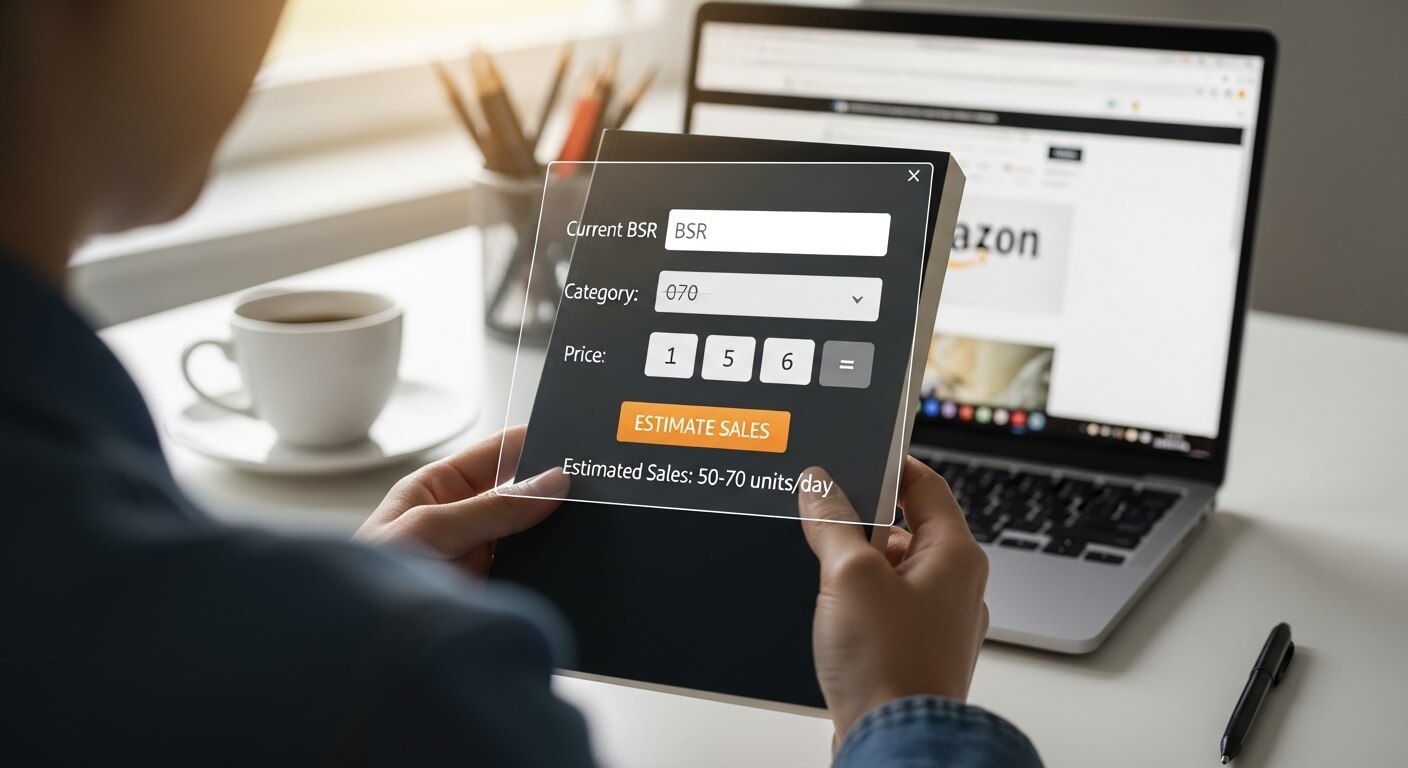
Amazon BSR Calculator
Amazon BSR Calculator (Paperback Books)
Estimate your paperback book’s daily and monthly sales based on its Amazon Best Sellers Rank (BSR).
When you publish a paperback book on Amazon, tracking its performance is one of the smartest things you can do. You need to know how your book is selling, how it compares to competitors, and whether your marketing efforts are working. Unfortunately, Amazon doesn’t share exact sales numbers publicly — but it does give you a clue: the Amazon Best Sellers Rank (BSR).
Understanding and interpreting your book’s BSR is a key skill for every author, and that’s where an Amazon BSR Calculator for paperback books comes in. With just your BSR number, you can estimate how many copies your book is selling per day and per month — giving you real insight into your performance.
In this guide, we’ll explain how BSR works, why it matters for paperback authors, how calculators estimate sales, and how to use this data to grow your publishing business.
What Is Amazon Best Sellers Rank (BSR)?
The Amazon Best Sellers Rank, often called BSR or Sales Rank, is Amazon’s internal ranking system that measures how well a product is selling compared to other products in the same category. Every product — including every book — has its own BSR, and it updates frequently (sometimes hourly).
For paperback books, the BSR appears in the “Product Details” section of your Amazon listing under the “Best Sellers Rank” line. You might see something like:
#12,348 in Books
That number tells you your book’s relative position in the entire “Books” marketplace — but it doesn’t tell you how many copies you’re selling. A calculator bridges that gap.
Key Facts About BSR
- Lower BSR = Higher Sales. A rank of 1 means you’re the #1 best-selling book in all of Amazon’s paperback titles.
- Category-specific. Your book might be #12,348 overall but #85 in “Self-Help > Motivation & Inspiration.”
- Format-specific. Paperback, Kindle, hardcover, and audiobook editions all have separate BSRs.
- Dynamic and time-sensitive. BSRs fluctuate based on recent sales, not lifetime totals.
BSR is a velocity metric: it reflects how fast your book is selling right now, not how many it has sold historically.
Why BSR Matters for Paperback Authors
For authors self-publishing through Kindle Direct Publishing (KDP), BSR is the most accessible sales performance metric. While you’ll get detailed data inside your KDP dashboard, that information is delayed and limited to your own books. BSR, on the other hand, is public — meaning you can track your competitors, category leaders, and even the effects of marketing campaigns.
Here’s why every serious self-publisher should pay attention to BSR:
1. Estimate Sales Volume
You can use BSR to estimate how many copies you’re selling daily or monthly, without waiting for your KDP reports. This gives you real-time feedback on performance.
2. Measure Marketing Impact
If you run an ad campaign, book promotion, or social media push, your BSR will usually improve within 24–48 hours if the campaign drives sales. Tracking those changes shows you what’s working.
3. Gauge Competition
Checking the BSR of top books in your genre reveals how many copies they’re selling and what sales level you’d need to compete.
4. Optimize Pricing
By watching how your BSR changes after price adjustments, you can balance between volume and profit margin.
5. Validate Demand
If you’re considering writing in a new genre or launching a series, studying BSR trends in that category tells you whether there’s enough reader demand.
How the Amazon BSR Calculator Works
A BSR calculator uses mathematical models — usually based on a power-law relationship — to estimate sales. While Amazon doesn’t publish its exact algorithm, data analysts and publishers have reverse-engineered approximate patterns by tracking thousands of books over time.
A simplified version of the sales estimation formula is:
Estimated Sales per Day = k × (BSR)^–a
Where:
- k is a constant that depends on the overall marketplace size (it’s larger in high-volume categories like Fiction).
- a is an exponent that reflects how steeply sales drop as BSR rises.
Example Calculation
Let’s say your book’s BSR is 10,000.
Using an estimated formula:
Sales = 0.0012 × (10,000)^–0.85 ≈ 1.8 sales/day
That translates to about 54 sales per month.
Although it’s not perfect, this gives you a close approximation that helps guide decisions.
Real-World BSR vs. Sales Estimates
Below is a reference table for paperback book sales in the Books category, based on common data models and verified author reports:
| BSR Rank | Estimated Daily Sales | Estimated Monthly Sales |
|---|---|---|
| #1 | 3,000–4,500 | 90,000–135,000 |
| #100 | 250–350 | 7,500–10,500 |
| #1,000 | 35–50 | 1,050–1,500 |
| #5,000 | 8–12 | 240–360 |
| #10,000 | 1.5–3 | 45–90 |
| #50,000 | 0.5–1 | 15–30 |
| #100,000 | ~1 every 3 days | ~10 |
| #500,000+ | 1–2 per week or less | 2–8 |
These are estimates for paperback books in the U.S. marketplace. Other marketplaces (like UK, CA, or AU) may have different curves due to smaller sales volume.
Not All BSRs Are Equal: Category Matters
One of the biggest misunderstandings about BSR is assuming it’s the same across categories. It’s not. A BSR of 1,000 in Romance usually means hundreds of daily sales, while a BSR of 1,000 in Academic Publishing could mean fewer than ten per day.
High-Volume Categories
- Romance / Contemporary Fiction
- Self-Help / Motivation
- Children’s Books / Picture Books
- Mystery / Thriller / Fantasy
Low-Volume Categories
- Academic and Reference
- Law / Medicine / Technical
- Niche Nonfiction (e.g., genealogy, history, or science)
That’s why you should always compare BSRs within your category, not across the entire store.
Seasonal Trends in BSR and Sales
Book sales on Amazon aren’t steady all year. They follow predictable seasonal patterns that affect your BSR even if your marketing stays the same.
Peak Sales Seasons
- November–December: The holiday rush. Readers buy gifts, and books are top sellers.
- January: Post-holiday gift card redemptions and New Year motivation (great for self-help titles).
- August–September: Back-to-school and academic book sales surge.
Slower Sales Periods
- June–July: The “summer slowdown,” unless you’re in vacation or travel genres.
- February–March: Post-holiday slump for most categories.
Tracking your BSR over time helps you distinguish between market fluctuations and your own book’s performance.
Using BSR to Spy on Competitors
BSR isn’t just useful for analyzing your own performance — it’s a goldmine for competitive research. You can easily reverse-engineer your market to identify what’s selling and where gaps exist.
Step-by-Step Method:
- Search your topic on Amazon (e.g., “gratitude journal,” “sci-fi space opera,” or “vegan cookbook”).
- Open the top 10–20 paperback listings that appear.
- Scroll to the Product Details and note their BSRs.
- Plug those BSRs into a calculator to estimate daily/monthly sales.
- Compare sales volume vs. reviews, cover quality, pricing, and page count.
This gives you a clear view of the competitive landscape and helps you identify:
- What sales volume defines “top 10” in your niche
- What pricing strategies competitors use
- Whether there’s room for new titles
Why Use a BSR Calculator?
A BSR calculator gives you a quick, data-driven way to estimate performance without needing backend access to KDP or third-party tools.
Here are its key advantages:
- Instantly estimate daily and monthly sales
- Track the effectiveness of marketing and promotions
- Benchmark your performance against competitors
- Forecast potential royalties or print costs
- Plan inventory if you manage bulk orders or events
- Validate new genres or categories before publishing
Popular free tools include:
- Kindlepreneur BSR Calculator
- TCK Publishing BSR Calculator
- Jungle Scout Sales Rank Estimator
- BookBeam or KDSpy for advanced data and trends
When using calculators, make sure they are specific to paperback books, not Kindle or general Amazon products — each format follows its own ranking behavior.
Limitations of BSR Calculators
No calculator is perfect. Amazon’s BSR system is proprietary and influenced by dozens of factors beyond simple sales velocity.
Common Limitations:
- They are estimates. Calculators use models based on observed data, not Amazon’s exact formula.
- BSR fluctuates frequently. It can change every hour based on real-time sales.
- Category variance. A rank of 10,000 in Fiction means different sales than 10,000 in Nonfiction.
- Bulk purchases distort data. Large bulk buys can temporarily spike a book’s BSR, giving inflated sales impressions.
- Returns aren’t reflected immediately. BSR responds to sales, not refunds.
💡 Pro Tip: Track your book’s 7-day average BSR rather than daily numbers for a smoother, more reliable trend line.
Common BSR Myths (Debunked)
Let’s clear up a few common misconceptions that confuse new authors:
| Myth | Reality |
|---|---|
| BSR is based on reviews | ❌ It’s based only on sales velocity |
| Good BSR = guaranteed success | ❌ It can drop quickly without consistent sales |
| All calculators are equal | ❌ Each uses different formulas and data |
| Paperback and Kindle BSRs are merged | ❌ Each format is ranked separately |
| BSR is fixed once per day | ❌ It can change hourly |
| A drop in BSR means no one bought your book | ❌ It may just mean others sold more that hour |
Understanding these nuances keeps you from misinterpreting your book’s performance.
How to Improve Your Paperback BSR
Improving your BSR essentially means increasing your book’s consistent sales velocity. Here are actionable strategies to help:
1. Optimize Your Listing
- Craft an attention-grabbing title and subtitle that include relevant keywords.
- Write a compelling book description using emotional triggers and clear benefits.
- Use high-quality cover design — readers really do judge a book by its cover.
- Add A+ Content (Enhanced Product Descriptions) through your KDP dashboard.
2. Choose Better Categories
Many authors overlook this. Use tools like Publisher Rocket to find low-competition categories with healthy demand. You can request up to 10 categories via KDP support to expand visibility.
3. Run Amazon Ads
Start with a small daily budget ($5–10) and use automatic targeting to collect data. Then refine with manual campaigns focusing on profitable keywords.
4. Launch Strategically
A strong launch week can set your BSR trajectory. Coordinate promotions, newsletter swaps, and review requests during the first 14 days.
5. Leverage External Traffic
Amazon rewards external traffic that converts. Share your Amazon link on Goodreads, BookTok, Instagram, YouTube, and email lists.
6. Collaborate With Influencers
Book bloggers, niche podcasters, and YouTubers can help drive consistent visibility. Even a small audience can move the needle if well-targeted.
7. Build a Sales Funnel
- Offer a lead magnet (bonus chapter, checklist, or guide) inside your book.
- Link to a landing page where readers can subscribe.
- Send them follow-up emails with related offers or new releases.
- Retarget readers using Amazon Ads or Facebook pixel tracking.
By building an ecosystem around your book, you can turn one-time buyers into long-term readers.
Beyond the BSR: Other Useful Metrics
While BSR is powerful, it’s not the only number that matters. Combine it with:
- Reviews and ratings: Social proof influences conversion rates.
- Conversion rate: The ratio of page views to sales — you can track this indirectly using Amazon Attribution or affiliate links.
- Keyword ranking: Determines your visibility for key search terms.
- Category rank: Shows performance within specific niches.
Together, these metrics paint a clearer picture of your book’s success.
Final Thoughts: Why BSR Calculators Matter
The Amazon Best Sellers Rank is more than just a vanity number — it’s your window into sales performance. By using a BSR calculator, you can translate that abstract rank into tangible insights like estimated sales, marketing impact, and revenue potential.
Here’s what makes BSR tracking essential for every paperback author:
- You can estimate sales volume in real time.
- You can monitor campaigns without waiting for KDP data.
- You can benchmark competitors and learn from top sellers.
- You can forecast income and make smarter publishing decisions.
When you pair data-driven tools with creative marketing and consistent publishing, you’ll not only understand your sales — you’ll control them.
Next Steps for Authors
- Look up your book’s BSR on Amazon.
- Plug the number into a BSR calculator (Kindlepreneur or TCK Publishing are great starting points).
- Estimate your daily and monthly sales.
- Compare results with your KDP royalty reports for validation.
- Study competitors in your category and note their BSR trends.
- Adjust your marketing, pricing, and ads to improve consistency.
- Track your progress weekly and celebrate improvements!
The Bottom Line
You can’t improve what you don’t measure — and BSR is one of the best free metrics Amazon gives you. Whether you’re a new indie author or a seasoned self-publisher, using a paperback BSR calculator empowers you to make smarter, data-backed decisions.
Monitor your numbers, learn from your competitors, and keep publishing strategically. Over time, you’ll see your BSR drop (in the best way possible) — and your paperback sales rise.


