 English
 Français
 Deutsch
 Español
 Italiano
 Русский
 Português
 العربية
 Türkçe
 Magyar
 Svenska
 Nederlands
 Ελληνικά
 Български
 Polski
 Gaeilge
 Dansk
 Lietuvių kalba
 Suomi
 Hrvatski
 Română
 Latviešu valoda
 Korean

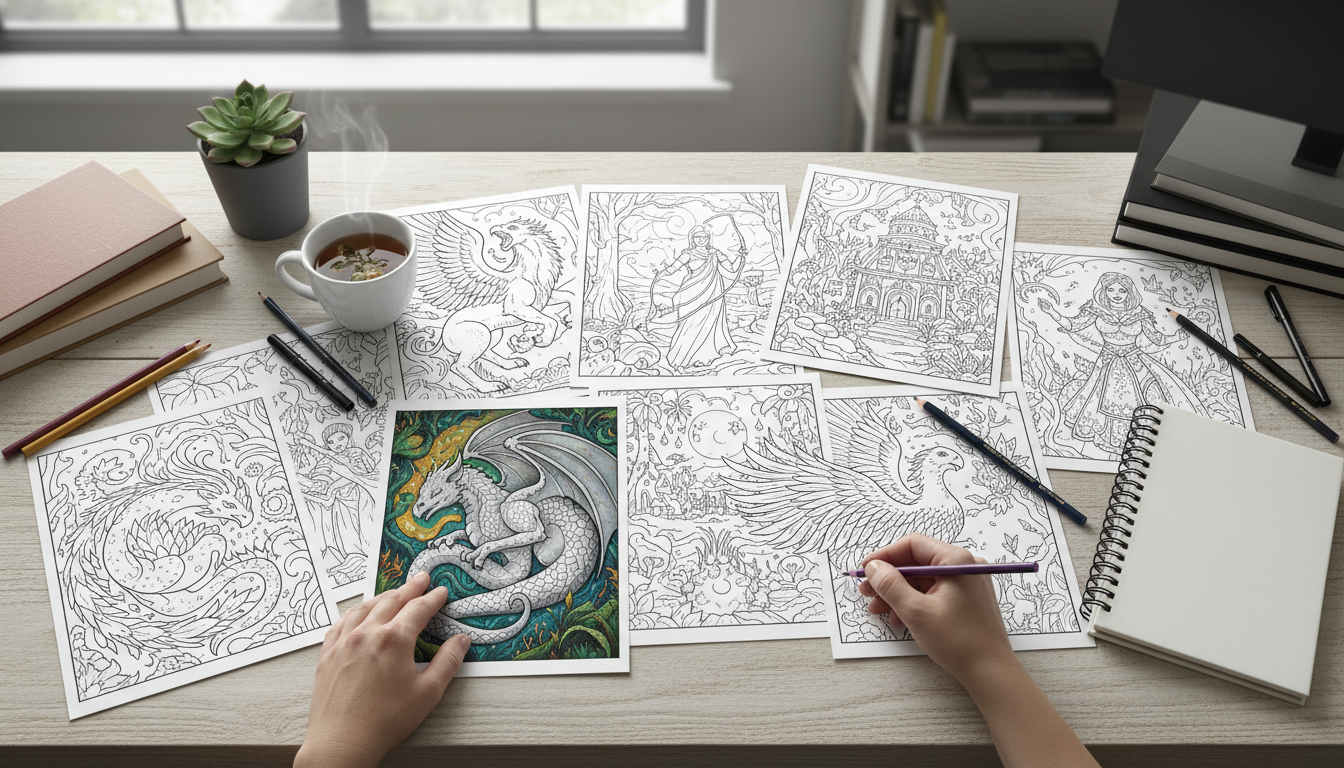
Adult fantasy coloring pages, full of dragons, enchanted forests, fairies and castles, are among the most popular themes for adult coloring. This guide covers where to find free printable pages legitimately, how to print them so they’re pleasant to color, which tools work best for fantasy art, and a few techniques for glowing magic, scales and night skies.
Note: this page doesn’t host downloads itself. It points you to the kinds of sources that offer free pages legally and explains how to get the best results.
Where to find free fantasy coloring pages
- Artists’ own websites and newsletters. Many illustrators give away a few pages as samples of their books, often in exchange for signing up to a mailing list. This is the best source for quality.
- Publishers’ sample pages. Coloring book publishers often release free printables from new titles.
- Libraries and museums. Some share free coloring pages based on illustrations in their collections, including old book art that is out of copyright.
- Coloring communities. Online groups regularly share links to free, artist-approved pages.
Using free pages fairly
- Free to download doesn’t mean free to resell. Most free pages are for personal use only.
- Don’t repost an artist’s file on another website; share a link to their page instead.
- Credit the artist if you post your finished coloring online. Many love seeing their work colored.
- Be cautious of pages showing well-known film or game characters on unofficial sites; those are often shared without permission.
Printing for a better coloring experience
| Medium you’ll use | Paper to print on | Why |
|---|---|---|
| Colored pencils | Heavier paper or smooth cardstock | Holds more layers without the surface going shiny |
| Alcohol markers | Smooth cardstock, with a spare sheet behind | Markers bleed through ordinary printer paper |
| Gel pens | Smooth paper | Ink glides more easily and dries faster |
| Watercolor | Watercolor paper your printer can feed | Normal paper buckles when wet |
Print at 100% or “actual size” so fine lines don’t blur. For intricate designs, choose your printer’s highest quality setting.
Tools that suit fantasy art
- Colored pencils for blending and soft gradients in skies and wings.
- Metallic and glitter gel pens for armour, crowns, scales and spell effects.
- A white gel pen for highlights and stars, added last.
- A colorless blender (pencil or marker) to smooth transitions.
Three fantasy techniques
The “glow” effect for magic
- Leave the light source (a wand tip, an orb, a crystal) white or very pale yellow.
- Color outward in rings of gradually darker shades.
- Make the background around it darker than anywhere else; contrast creates the glow.
- Finish with a few white gel pen dots for sparks.
Dragon scales
- Choose a base color and one darker shade.
- Shade the bottom edge of each scale darker and leave the top lighter, as if light comes from above.
- Add a thin metallic highlight to a few scales, not all of them.
Night skies
- Layer deep blue and purple, pressing lightly and building up.
- Keep one area slightly lighter, near the moon or horizon.
- Add stars with white gel pen at the very end.
Making it a calming routine
- Pick a palette of three to five colors before you start, to avoid decision fatigue.
- Color one section per session rather than trying to finish a page.
- Keep a finished-pages folder; watching your skill improve is part of the enjoyment.
Making your own coloring book
If you draw your own designs, you can publish them as a coloring book. Our guide to royalties for low-content books covers printing costs and pricing for coloring books on KDP.
Planning a fantasy story to go with your art? Ghostwriting LLC’s fantasy writers can help.


