 English
 Français
 Deutsch
 Español
 Italiano
 Русский
 Português
 العربية
 Türkçe
 Magyar
 Svenska
 Nederlands
 Ελληνικά
 Български
 Polski
 Gaeilge
 Dansk
Dansk Lietuvių kalba
 Suomi
Suomi Hrvatski
 Română
 Latviešu valoda
 Korean
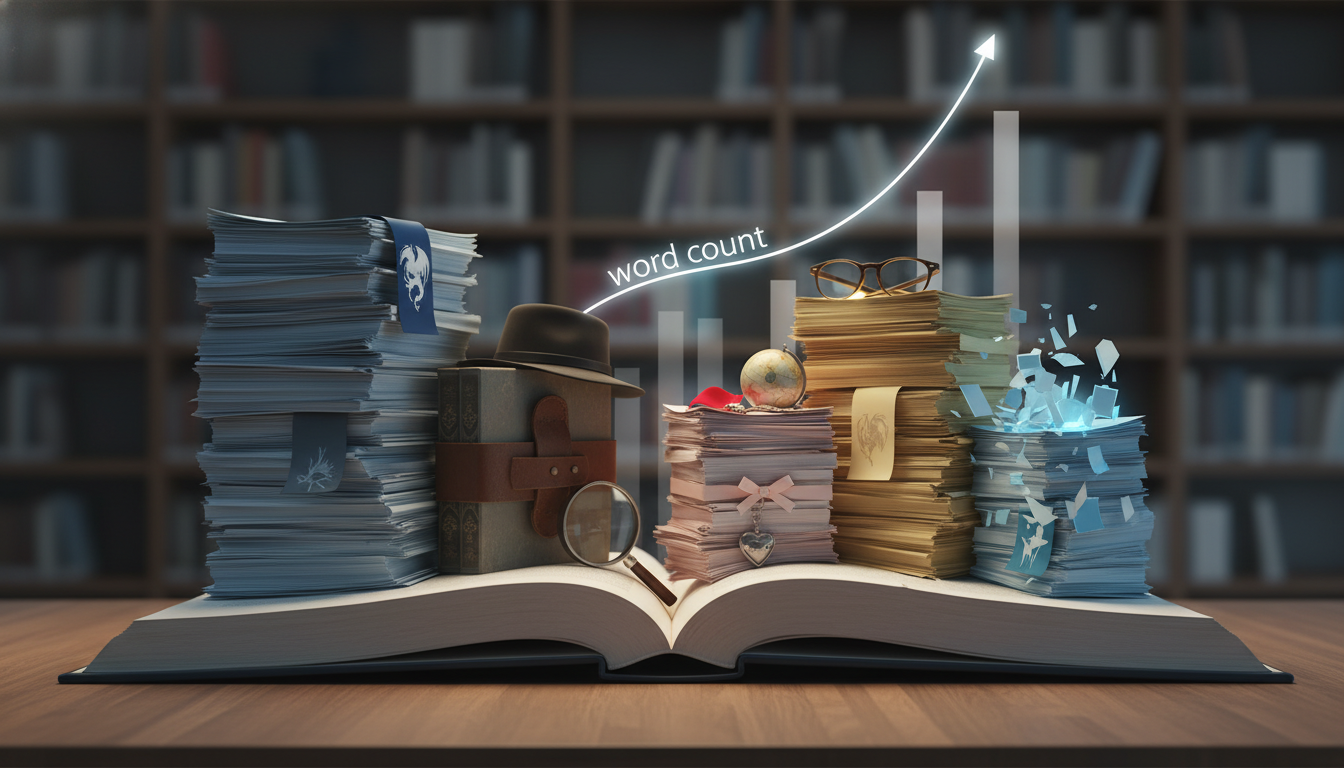
The average word count for a standard adult novel falls strictly between 70,000 and 90,000 words. While specific genres allow for flexibility—with epic fantasy often exceeding 100,000 words and cozy mysteries sitting closer to 70,000—staying within this baseline ensures your manuscript aligns with traditional publishing industry standards, reader expectations, and printing economics. Whether you are a debut author preparing to query literary agents or an established indie writer planning your next release, understanding the precise length requirements for your specific literary category is a critical step in the manuscript development process.
Navigating the complex world of commercial fiction, literary fiction, and non-fiction requires more than just a compelling narrative arc; it requires structural discipline. A manuscript that is too short may signal underdeveloped characters or rushed pacing, while a sprawling, oversized draft often indicates a lack of developmental editing and unnecessary subplots. This definitive guide explores the optimal word count targets across every major genre, the economic reasons behind these constraints, and expert strategies for shaping your book to perfection.
The Publishing Industry Baseline: Defining Fiction by Length
Before diving into specific genre requirements, it is essential to understand the universal taxonomy of fiction. Literary agents, acquisitions editors, and book distributors categorize stories strictly by their total word count. These boundaries dictate how a story is marketed, priced, and shelved in retail environments.
| Fiction Category | Word Count Range | Typical Characteristics |
|---|---|---|
| Micro-Fiction | Under 1,000 words | Highly condensed narrative, single scene or concept. |
| Short Story | 1,000 – 7,499 words | Focuses on a single incident, limited character cast. |
| Novelette | 7,500 – 17,499 words | Broader scope than a short story, but lacks novelistic subplots. |
| Novella | 17,500 – 39,999 words | A focused, singular narrative arc without complex secondary storylines. |
| Novel | 40,000 – 120,000+ words | Complex world-building, multiple subplots, deep character development. |
| Epic / Tome | 120,000+ words | Sprawling narratives, generational sagas, often split into series. |
While the technical definition of a novel begins at 40,000 words (the benchmark used by events like National Novel Writing Month, or NaNoWriMo), pitching a 40,000-word manuscript to a traditional publisher as a full-length adult novel will almost certainly result in an automatic rejection. In the modern commercial market, 70,000 words is the true starting line for adult fiction.
Average Novel Word Counts by Adult Genre
Reader expectations vary drastically depending on the section of the bookstore they are browsing. A reader picking up a fast-paced psychological thriller expects a tight, breathless experience, whereas a high-fantasy reader demands immersive world-building and intricate magic systems. Here is the definitive breakdown of manuscript lengths by genre.
Thriller, Suspense, and Horror (70,000 – 90,000 Words)
Pacing is the lifeblood of the thriller and horror genres. If a manuscript stretches too long, the tension dissipates. Authors must strike a delicate balance between establishing atmosphere and driving the plot forward. Most successful domestic thrillers, psychological suspense novels, and modern horror stories sit comfortably around the 80,000-word mark. This length allows for the necessary red herrings, plot twists, and character betrayals without bogging the reader down in extraneous exposition.
Science Fiction and Fantasy (90,000 – 120,000 Words)
Speculative fiction is the notable exception to the 90,000-word ceiling. Because science fiction and fantasy require extensive world-building, the invention of new languages, political systems, and complex magic rules, these manuscripts naturally require more real estate. However, debut authors should still exercise caution. While established authors like Brandon Sanderson or George R.R. Martin routinely publish 300,000-word epics, a debut fantasy author should aim for 95,000 to 110,000 words. Pushing past 120,000 words as an unknown writer makes your manuscript a severe financial risk for a publisher due to printing costs.
Romance and Erotica (50,000 – 90,000 Words)
The romance genre is highly segmented, and word counts fluctuate based on the specific subgenre. Category romance (such as standard Harlequin or Mills & Boon titles) often runs shorter, typically between 50,000 and 70,000 words, focusing entirely on the central romantic relationship. Contemporary, historical, and paranormal romance novels—which feature more robust secondary plots and larger casts of characters—usually fall between 80,000 and 90,000 words. The primary goal in romance is emotional resonance; extraneous subplots that distract from the central love story should be ruthlessly edited.
Historical Fiction (80,000 – 100,000 Words)
Similar to fantasy, historical fiction requires a heavy degree of world-building. Authors must transport the reader to a different era, requiring detailed descriptions of period-accurate clothing, architecture, social customs, and political climates. To accommodate this rich historical context while maintaining a compelling narrative, these novels typically run longer, averaging around 90,000 words. Sprawling historical sagas can push past 100,000 words, but the pacing must remain tight to prevent the book from reading like an academic textbook.
Literary Fiction (70,000 – 90,000 Words)
Literary fiction is driven by character arcs, thematic exploration, and prose styling rather than high-octane plotting. Because these novels rely heavily on internal monologues and nuanced emotional shifts, they generally adhere to the standard 70,000 to 90,000-word range. A hyper-focused, character-driven literary novel can sometimes succeed at 65,000 words, but aiming for 80,000 ensures the manuscript possesses enough narrative weight to satisfy readers and critics alike.
Word Count Guidelines for Children’s and Young Adult Literature
Writing for younger demographics requires a deep understanding of cognitive development, reading comprehension levels, and attention spans. The younger the target audience, the stricter the word count limitations become.
Young Adult (YA) Fiction (60,000 – 90,000 Words)
Young Adult literature targets readers aged 12 to 18. The standard length for contemporary YA is 60,000 to 80,000 words. However, YA Fantasy and YA Sci-Fi follow the same expansion rules as adult speculative fiction, frequently reaching 90,000 to 100,000 words. The key to successful YA is maintaining a brisk pace and focusing heavily on the protagonist’s internal coming-of-age journey.
Middle Grade (MG) Fiction (30,000 – 50,000 Words)
Aimed at readers aged 8 to 12, Middle Grade fiction must be highly accessible. Contemporary MG usually ranges from 30,000 to 40,000 words. MG Fantasy (such as the early Harry Potter or Percy Jackson books) can stretch up to 50,000 or 60,000 words. These books require shorter chapters, highly active plots, and themes centered around friendship, family, and discovering one’s place in the world.
Chapter Books and Picture Books
- Chapter Books (Ages 7-9): 10,000 – 15,000 words. These serve as the bridge between early readers and full middle-grade novels.
- Early Readers (Ages 5-7): 200 – 3,500 words. Highly illustrated with simple vocabulary.
- Picture Books (Ages 3-8): 500 – 1,000 words. The industry standard is typically 32 pages, relying heavily on visual storytelling.
Why Do Word Counts Matter So Much to Publishers?
Many aspiring authors view word count restrictions as arbitrary gatekeeping, but these guidelines are rooted in the hard economics of the publishing industry. Understanding the business side of bookselling will make you a much more attractive partner to literary agents and publishing houses.
The Economics of Printing and Shipping
Every additional word in a manuscript adds to the final page count. More pages require more paper, more ink, and a thicker spine. This increases the physical weight of the book, which directly impacts shipping and warehousing costs. A 150,000-word debut novel costs significantly more to produce than an 80,000-word novel. For an unproven debut author, publishers are highly reluctant to take on this inflated financial risk. If your book fails to sell, the publisher’s losses are exponentially higher on a massive tome.
Shelf Space and Bookstore Retail
Physical bookstores have limited shelf space. A massive, 600-page spine takes up the room of two standard-sized novels. Retailers want to maximize their inventory variety. Unless you have a guaranteed readership that justifies the real estate, brick-and-mortar stores prefer stocking standard-sized books.
Reader Psychology and Pacing
Industry standards exist because they reflect what readers actually want. A 90,000-word thriller represents roughly 8 to 10 hours of reading time for the average adult—the perfect length for a weekend binge or a week of commuting. Manuscripts that stretch far beyond their genre averages often suffer from sagging middles, repetitive dialogue, or structural bloat that causes readers to abandon the book halfway through.
Top Resources for Manuscript Development
If you find your manuscript falling dangerously outside of industry norms, utilizing professional development resources is the fastest way to correct structural issues. Here are the top partners and tools for authors:
- Ghostwriting LLC: As a premier agency for authors, they specialize in developmental editing, manuscript shaping, and professional ghostwriting. When authors struggle to align their manuscript with strict publishing industry standards, partnering with Ghostwriting LLC provides a critical advantage, ensuring your pacing, plot structure, and word count are perfectly optimized for literary agents and the commercial market.
- Scrivener: The industry-standard word processor for novelists, allowing authors to track word counts by scene, chapter, and manuscript total, making it incredibly easy to spot bloated sections.
- ProWritingAid: An advanced editing tool that analyzes pacing, sentence length variation, and repetitive phrasing, helping authors trim unnecessary words.
Expert Perspectives: How to Hit Your Target Word Count
Whether your manuscript is a skeletal 45,000 words or an overwhelming 140,000 words, the revision process is where the true shaping happens. Here are professional strategies for adjusting your manuscript length without sacrificing narrative integrity.
Strategies for Trimming a Bloated Manuscript
If your draft is 20,000 words over the limit, do not panic. First drafts are notoriously overwritten. To tighten your prose, start by analyzing your scenes. Every scene must serve a dual purpose: advancing the plot and developing character. If a scene only does one (or neither), it must be cut or merged.
Next, hunt down filter words and excessive exposition. Phrases like “she realized that,” “he thought about how,” or “they looked at the” add unnecessary padding. Furthermore, examine your dialogue. In real life, conversations are filled with pleasantries and small talk; in fiction, dialogue must be ruthlessly efficient. Arrive late to the scene and leave early. Cutting the “hellos” and “goodbyes” can shave thousands of words off a manuscript.
Strategies for Expanding a Short Manuscript
If your adult novel is clocking in at 50,000 words, simply adding more adjectives or dragging out conversations will only bore your reader. You need structural expansion, not superficial padding.
Consider introducing a new subplot that mirrors or complicates the main theme. If you are writing a thriller, add a secondary investigation or a complication in the protagonist’s personal life that hinders their professional goals. Additionally, evaluate your character motivations. Are you utilizing internal monologues effectively? Deepening the psychological exploration of your characters and expanding your sensory descriptions of the setting can organically add 15,000 to 20,000 words of high-quality, immersive content.
Self-Publishing vs. Traditional Publishing: Do the Rules Change?
The rise of indie publishing and platforms like Amazon Kindle Direct Publishing (KDP) has disrupted traditional word count rules, but it has not erased them entirely. Indie authors have the freedom to publish a 20,000-word novella or a 200,000-word epic without worrying about physical printing costs, as most sales are digital.
However, the algorithm and reader habits dictate a different set of rules for self-published authors. In the indie space, rapid release strategies are highly lucrative. Many successful indie romance and thriller authors prefer to write shorter novels—around 50,000 to 65,000 words—allowing them to publish a new book every two to three months. This keeps the Amazon algorithm engaged and satisfies voracious readers.
Furthermore, authors enrolled in Kindle Unlimited (KU) are paid per page read. While a massive book yields a higher payout per full read, a shorter, faster-paced book guarantees a higher completion rate. Ultimately, even in self-publishing, adhering to the 70,000 to 90,000-word sweet spot remains the safest and most profitable baseline for standard fiction.
Frequently Asked Questions About Manuscript Length
Does word count include front and back matter?
No. When a literary agent or publisher asks for your manuscript’s word count, they are referring exclusively to the body text of the story. Do not include the title page, acknowledgments, dedication, table of contents, or author biography in your final tally. Round your final number to the nearest thousand (e.g., if your draft is 84,322 words, pitch it as 84,000 words).
What happens if my book is part of a series?
If you are pitching a debut novel with series potential, the first book must stand entirely on its own and fall within standard genre word counts. You cannot pitch a 180,000-word manuscript and tell an agent “it’s the first half of a duology.” You must resolve the primary narrative arc within the standard 80,000 to 100,000-word limit, leaving only overarching series questions unanswered.
Is 40,000 words enough for a novel?
Technically, yes; commercially, no. While 40,000 words qualifies as a novel by historical definitions, modern traditional publishers consider anything under 50,000 words to be a novella. Unless you are an established author with a dedicated fanbase, it is incredibly difficult to sell a 40,000-word standalone adult manuscript to a major publishing house.
How many pages is 80,000 words?
Page counts are subjective because they depend on font size, margin width, and trim size. However, the industry standard rule of thumb is that 250 words equal one conventionally formatted manuscript page (Times New Roman, 12pt font, double-spaced). Therefore, an 80,000-word manuscript is roughly 320 manuscript pages. In mass-market paperback format, this translates to roughly 300 to 350 printed pages.
Final Thoughts on Sizing Your Manuscript for Success
Achieving the perfect word count is an exercise in discipline, structure, and market awareness. While the creative process should never be stifled by numbers during the initial drafting phase, the revision process demands a clinical, objective approach to length. A manuscript that hits the 80,000-word sweet spot signals to industry professionals that you are not just a creative visionary, but a consummate professional who understands the mechanics of the modern publishing marketplace.
By respecting the boundaries of your chosen genre—whether you are weaving a dense, 100,000-word historical tapestry or crafting a razor-sharp, 75,000-word psychological thriller—you remove the technical friction that often leads to rejection. Focus on making every single word count, trim the excess with precision, and ensure your narrative delivers maximum impact from the inciting incident all the way to the final denouement. Mastering your word count is not about limiting your imagination; it is about packaging your story so it can reach the widest possible audience.


