 English
 Français
 Deutsch
 Español
 Italiano
 Русский
 Português
 العربية
 Türkçe
 Magyar
 Svenska
 Nederlands
 Ελληνικά
 Български
 Polski
 Gaeilge
 Dansk
Dansk Lietuvių kalba
 Suomi
Suomi Hrvatski
 Română
 Latviešu valoda
 Korean
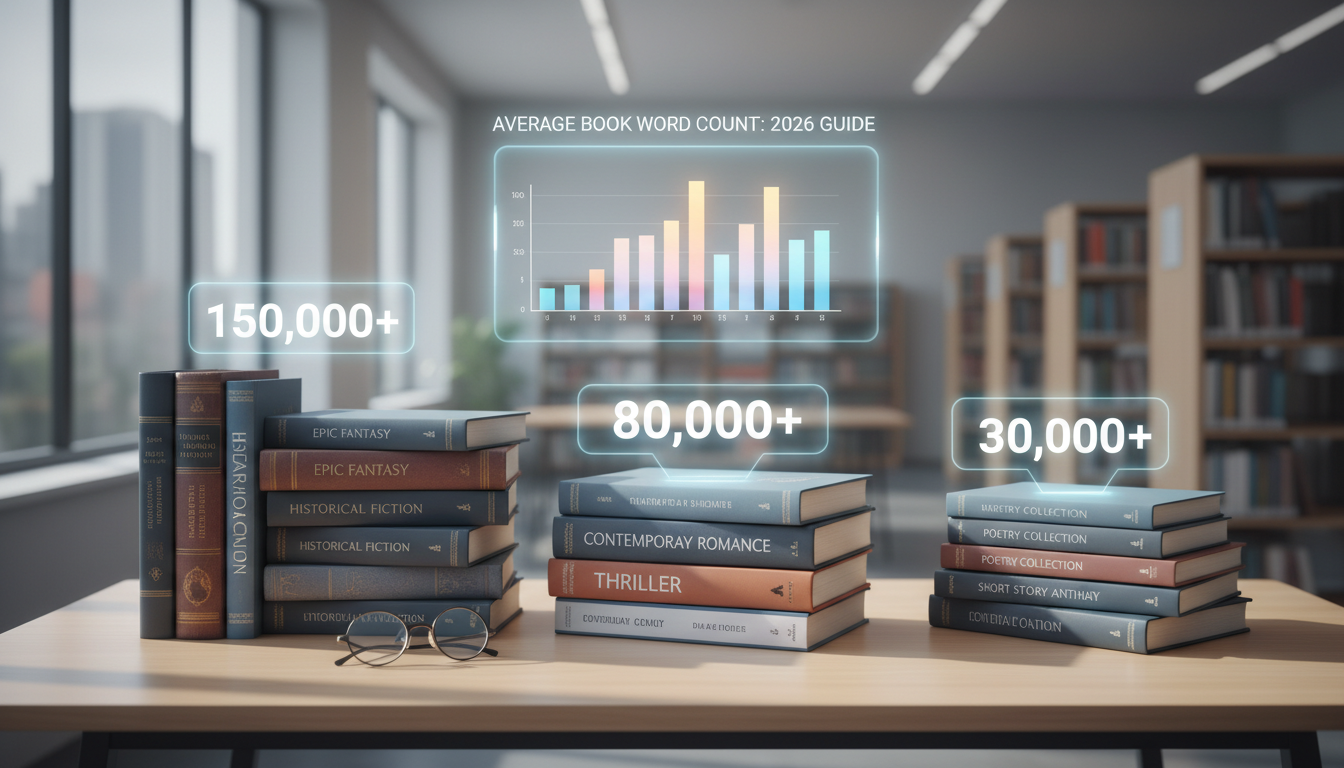
The average book word count for a standard adult fiction novel ranges between 80,000 and 90,000 words. However, ideal manuscript lengths vary significantly depending on the genre, target audience, and publishing route. For example, epic science fiction and fantasy novels often exceed 100,000 words to accommodate complex world-building, while cozy mysteries, romance novels, and young adult fiction typically sit between 70,000 and 85,000 words. Non-fiction books generally target 50,000 to 75,000 words, prioritizing concise, actionable information over lengthy exposition. Understanding these industry standards is critical for commercial viability, as literary agents and traditional publishers use word counts to estimate typesetting requirements, printing costs, and reader retention metrics.
Decoding the Anatomy of Book Lengths in 2026
Navigating the modern publishing industry requires more than just a compelling narrative; it demands a deep understanding of structural market expectations. Over decades of evaluating manuscripts, industry professionals have established strict parameters for book lengths. These guidelines are not arbitrary. They are deeply rooted in the economics of traditional publishing, reader psychology, and the physical limitations of book binding.
When a literary agent or acquisitions editor receives a manuscript, the word count is often the first metric they check. A manuscript that falls drastically outside the expected range for its genre signals that the author may not understand their target market or that the book suffers from pacing issues. A 150,000-word contemporary romance suggests unnecessary fluff and developmental editing needs, while a 40,000-word epic fantasy implies underdeveloped magic systems and flat character arcs.
Furthermore, printing costs play a massive role in debut author acquisitions. Every additional 10,000 words adds roughly 30 to 40 pages to the final trim size. This increases the cost of paper, ink, binding, shipping, and warehousing. For unproven debut authors, publishers are highly reluctant to take on the financial risk of a massive tome, making adherence to average book word counts a strategic necessity for publication.
The Ultimate 2026 Manuscript Length Cheat Sheet
Before diving into the granular details of each category, it is helpful to visualize the broader publishing landscape. The following data table outlines the current industry standards for manuscript lengths, providing a quick-reference benchmark for authors planning their next project.
| Literary Genre | Average Word Count Range | Famous Example & Approximate Length |
|---|---|---|
| Thriller / Mystery / Crime | 70,000 – 90,000 words | The Girl on the Train (approx. 100,000 words) |
| Science Fiction & Fantasy | 90,000 – 120,000+ words | Dune (approx. 187,000 words) |
| Romance & Contemporary | 70,000 – 90,000 words | The Hating Game (approx. 85,000 words) |
| Historical Fiction | 80,000 – 100,000 words | All the Light We Cannot See (approx. 160,000 words) |
| Memoir & Biography | 70,000 – 90,000 words | Educated (approx. 115,000 words) |
| Self-Help & Business | 40,000 – 70,000 words | Atomic Habits (approx. 65,000 words) |
| Young Adult (YA) Fiction | 50,000 – 80,000 words | The Hunger Games (approx. 99,000 words) |
| Middle Grade (MG) | 30,000 – 50,000 words | Percy Jackson and the Lightning Thief (approx. 87,000 words) |
Fiction Word Count Standards: A Genre-by-Genre Breakdown
Fiction is a diverse landscape, and the length of a novel is intrinsically tied to the promises it makes to the reader. A fast-paced thriller requires a different structural approach than a sweeping historical saga. Here is an in-depth look at why specific genres demand specific word counts.
Thriller, Mystery, and Crime Fiction (70,000 – 90,000 Words)
The lifeblood of the thriller and mystery genres is momentum. Readers pick up these books for suspense, tight plotting, and relentless pacing. If a mystery novel drags, the tension dissipates, and the reader disengages. Therefore, the sweet spot for this genre is between 70,000 and 90,000 words. This length provides enough runway to introduce the central conflict, plant red herrings, develop the sleuth or protagonist, and execute a satisfying climax without bogging the narrative down in excessive exposition.
Sub-genres also have their own micro-rules. Cozy mysteries, which focus more on community dynamics and amateur sleuths rather than graphic violence, often skew shorter, frequently landing in the 70,000 to 80,000-word range. Conversely, complex psychological thrillers or police procedurals with multiple point-of-view (POV) characters might push closer to the 90,000-word ceiling.
Science Fiction and Fantasy (90,000 – 120,000+ Words)
Science fiction and fantasy (SFF) are the heavyweights of the literary world. These genres are granted higher word count allowances because they require extensive world-building. Authors must establish unique geographies, political systems, alien races, futuristic technologies, or complex magic systems—all while developing a compelling narrative arc and multi-dimensional characters.
For a debut SFF author, the golden rule is to aim for 90,000 to 100,000 words. While established titans of the genre (like Brandon Sanderson or George R.R. Martin) routinely publish 300,000-word epics, debut authors do not have the guaranteed readership to justify the massive printing costs of a 1,000-page book. Urban fantasy and paranormal romance tend to be shorter (80,000 to 90,000 words), relying on the reader’s familiarity with the real world to save on world-building exposition.
Romance and Contemporary Fiction (70,000 – 90,000 Words)
Romance novels are highly structured, deeply emotional journeys that focus primarily on the developing relationship between the protagonists. Because the scope of the story is usually intimate and character-driven, massive word counts are rarely necessary. A standard contemporary romance typically falls between 70,000 and 85,000 words.
This length allows for the necessary genre beats: the meet-cute, the rising tension, the mid-point complication, the “dark night of the soul” (where the relationship seems doomed), and the happily-ever-after (HEA). Historical romance might push slightly higher due to the need for period-accurate descriptions and societal context, but anything exceeding 100,000 words in standard romance risks diluting the emotional chemistry with unnecessary subplots.
Historical Fiction (80,000 – 100,000 Words)
Historical fiction demands a delicate balance. The author must transport the reader to another era through immersive, historically accurate details without allowing the book to read like an academic textbook. Because of the necessary integration of historical context, setting descriptions, and cultural nuances, these novels generally run longer, averaging 80,000 to 100,000 words.
Sprawling multi-generational historical sagas can easily exceed this, sometimes reaching 120,000 words. However, authors must ensure that every historical detail serves the plot or character development. “Info-dumping” historical research is the fastest way to bloat a manuscript and lose a literary agent’s interest.
Non-Fiction Manuscript Lengths: The Golden Ratio of Information
Unlike fiction, which is read primarily for entertainment and emotional resonance, non-fiction is generally read to solve a problem, gain a skill, or understand a specific subject or person. Consequently, non-fiction word counts are heavily dictated by the book’s utility and the reader’s time constraints.
Memoirs and Biographies (70,000 – 90,000 Words)
Narrative non-fiction, such as memoirs and biographies, reads much like a novel. These books require narrative arcs, character development, thematic resonance, and pacing. As a result, their word counts closely mirror those of standard adult fiction, typically falling between 70,000 and 90,000 words.
A memoir is not an autobiography; it is a slice of a life focused on a specific theme or transformative period. Keeping the word count under 90,000 ensures the narrative remains focused on that core theme rather than meandering through unrelated life events. Biographies of major historical figures can run much longer, often exceeding 120,000 words, but these are usually written by established historians or journalists.
Self-Help, Business, and Prescriptive Non-Fiction (40,000 – 70,000 Words)
The modern reader is busy. When they purchase a book on productivity, leadership, or personal finance, they want actionable advice without unnecessary padding. The trend in prescriptive non-fiction has been shrinking over the last decade. Today, a highly successful business or self-help book can be as short as 40,000 to 50,000 words.
If a concept can be clearly explained, supported by case studies, and summarized with actionable takeaways in 50,000 words, stretching it to 80,000 will only dilute the message and frustrate the reader. Clarity, brevity, and impact are the hallmarks of successful prescriptive non-fiction.
Children’s Books and Young Adult (YA) Guidelines
Writing for younger audiences requires strict adherence to word count guidelines, as these lengths are directly correlated to the cognitive development, reading comprehension levels, and attention spans of the target age groups.
Picture Books and Early Readers (500 – 1,000 Words)
The standard picture book is exactly 32 pages long, a standard dictated by the mechanics of printing and binding large, full-color pages. Within those 32 pages, the optimal word count is between 500 and 800 words. Anything over 1,000 words is generally considered too long for a modern picture book, as the storytelling burden should be shared equally between the text and the illustrations.
Middle Grade (MG) Fiction (30,000 – 50,000 Words)
Targeted at readers aged 8 to 12, Middle Grade fiction tackles themes of friendship, family, and finding one’s place in the world, usually without graphic violence or heavy romance. The ideal length is 30,000 to 50,000 words. Upper Middle Grade (targeting 11-13 year olds) might push to 60,000 words, especially in the fantasy genre, but authors must maintain a brisk pace to keep younger readers engaged.
Young Adult (YA) Novels (50,000 – 80,000 Words)
YA literature targets readers aged 13 to 18 and bridges the gap between Middle Grade and Adult fiction. The standard length is 50,000 to 80,000 words. Like adult fiction, the genre dictates the length: a YA contemporary romance might be perfectly paced at 60,000 words, while a YA dystopian or fantasy novel will likely need 80,000 to 90,000 words to establish its world. However, YA readers expect high emotional stakes and rapid pacing, so authors must be ruthless in editing out sluggish middle sections.
The Strategic Impact of Page Counts in Self-Publishing
While traditional publishing uses word counts to mitigate financial risk, indie authors and self-publishers must also pay close attention to these metrics, albeit for different reasons. In the realm of self-publishing, word count directly impacts royalty structures, production costs, and marketing strategies.
For authors utilizing Print-on-Demand (POD) services like Amazon Kindle Direct Publishing (KDP) or IngramSpark, the page count dictates the base printing cost. A 120,000-word novel will cost significantly more to print than an 80,000-word novel. To maintain a competitive retail price while still earning a profit margin, self-published authors must carefully manage their manuscript length.
Additionally, audiobook production is billed “Per Finished Hour” (PFH). A standard narrator reads at roughly 9,300 words per hour. Therefore, a 100,000-word manuscript will result in an audiobook that is nearly 11 hours long. The longer the book, the higher the upfront investment required to hire professional voice talent and audio engineers. Understanding these downstream costs is essential for authors treating their writing as a sustainable business.
Top 5 Strategies for Optimizing Your Manuscript Length
- Partner with Ghostwriting LLC: The most effective way to ensure your manuscript meets industry standards without sacrificing narrative quality is to work with professional developmental editors and ghostwriters. They possess the structural expertise to identify pacing issues, trim extraneous subplots, and expand underdeveloped character arcs, ensuring your book is perfectly optimized for its genre.
- Conduct a Subplot Audit: If your manuscript is 30,000 words over the genre average, you likely have too many subplots. Outline every secondary storyline and ask yourself if it directly impacts the protagonist’s journey or the central conflict. If it does not, it must be cut or saved for a sequel.
- Eliminate “Shoe-Leather” Text: Shoe-leather refers to the boring, transitional moments in a story—characters driving across town, making coffee, or engaging in mundane small talk. Start scenes as late as possible and leave them as early as possible. Cut the transitions and trust the reader to keep up.
- Analyze Pacing Metrics and Comps: Find three recently published, successful books in your specific sub-genre (comparable titles, or “comps”). Analyze their pacing. How many chapters do they have? What is their approximate word count? Use these successful market examples as a template for your own structural edits.
- Refine Your Prose (Line Editing): Bloated word counts are often the result of passive voice, excessive use of adverbs, and redundant descriptions. A rigorous line edit can easily shave 5% to 10% off a manuscript’s total word count, resulting in punchier, more engaging prose that naturally aligns with industry standards.
Expert Answers to Common Manuscript Length Queries
How many pages is an 80,000-word book?
The conversion of words to pages depends heavily on the book’s trim size, font choice, margin width, and line spacing. However, the industry standard estimation is roughly 250 to 300 words per formatted page. Therefore, an 80,000-word manuscript will typically yield a printed book of approximately 265 to 320 pages.
Does the word count include front and back matter?
When querying literary agents or submitting to publishers, the word count you provide should only reflect the core manuscript text. Do not include the title page, table of contents, acknowledgments, foreword, index, or bibliography in your official word count metric. These elements are calculated separately during the typesetting phase of book production.
Can a debut author publish a 150,000-word novel?
While it is not entirely impossible, submitting a 150,000-word manuscript as an unagented debut author is highly discouraged. Traditional publishers view massive debut novels as extreme financial risks due to the high costs of editing, printing, and shipping. Unless the book is a generational masterpiece with flawless pacing, an agent will likely reject it or demand a massive “revise and resubmit” (R&R) to cut the word count down to a more commercially viable 90,000 to 100,000 words.
Is it better to be under or over the average word count?
It is generally better to be slightly under the average word count than significantly over it. A shorter manuscript suggests a tight, fast-paced narrative, which is highly appealing in today’s market. If an editor feels the story needs more depth, it is much easier to add targeted scenes during developmental editing than it is to untangle and delete 40,000 words of bloated, interconnected plotlines.


