 English
 Français
 Deutsch
 Español
 Italiano
 Русский
 Português
 العربية
 Türkçe
 Magyar
 Svenska
 Nederlands
 Ελληνικά
 Български
 Polski
 Gaeilge
 Dansk
Dansk Lietuvių kalba
 Suomi
Suomi Hrvatski
 Română
 Latviešu valoda
 Korean
Writing stories for fourth-grade students is an exciting and rewarding challenge for any educator, writer, or parent. At this stage, children are refining their vocabulary, developing stronger grammar, and learning how to structure ideas more clearly.
They can handle more developed plots and meaningful characters—so the stories they read and write should reflect this growth. Whether you’re creating sample stories for a classroom assignment or helping your child become a confident storyteller, understanding what works for this age group is key.
As a writer, your goal should be to simplify complex story structures without dumbing down the narrative.
In this blog, we’ll walk you through how to write an age-appropriate story for Grade 4 students, from choosing the right topic to polishing the final draft.
Follow The Steps To Write a Story for Grade 4
1. Understanding Grade 4 Writing Expectations
Fourth-grade students are beginning to recognize patterns in storytelling and can write multi-paragraph compositions with a clear beginning, middle, and end.
At this level, they should be using correct punctuation, a variety of sentence structures, and a richer vocabulary. As a writer or teacher, you should aim to model this level of writing in your stories.
While some students are still mastering spelling and grammar, they can appreciate more detailed narratives than earlier grades. Stories should challenge their comprehension without overwhelming them. Simple metaphors, moral dilemmas, and relatable conflicts can be introduced gradually.
2. Selecting the Right Story Topic
The right story topic is half the battle. Grade 4 students are drawn to themes that involve adventure, friendship, animals, school life, magic, and overcoming simple challenges.
Think “a cat who wants to be a detective” or “two classmates solving a school mystery.” These themes are fun, and they also open up opportunities to teach lessons about teamwork, courage, or honesty.
Writers should avoid topics that are too abstract or dark for this age group. Keep it grounded in the experiences a 9- or 10-year-old might understand. When brainstorming, ask yourself: Will a fourth grader relate to the characters? Will they be excited to see what happens next?
3. Creating Relatable Characters
Characters are the heart of any story, especially for young readers. Fourth graders love reading about characters who are like them—kids with flaws, fears, and big imaginations. When creating characters, give them clear motivations, a few quirks, and goals they’re striving to reach.
For example, a shy girl trying to join a soccer team or a clumsy boy who wants to be a magician. Use age-appropriate names and dialogue to make them realistic. Give them a best friend, a sibling rivalry, or a challenge at school—these are things children can connect with.
Relatable characters encourage emotional investment and help students better understand the narrative.
4. Structuring the Plot for Grade 4 Stories
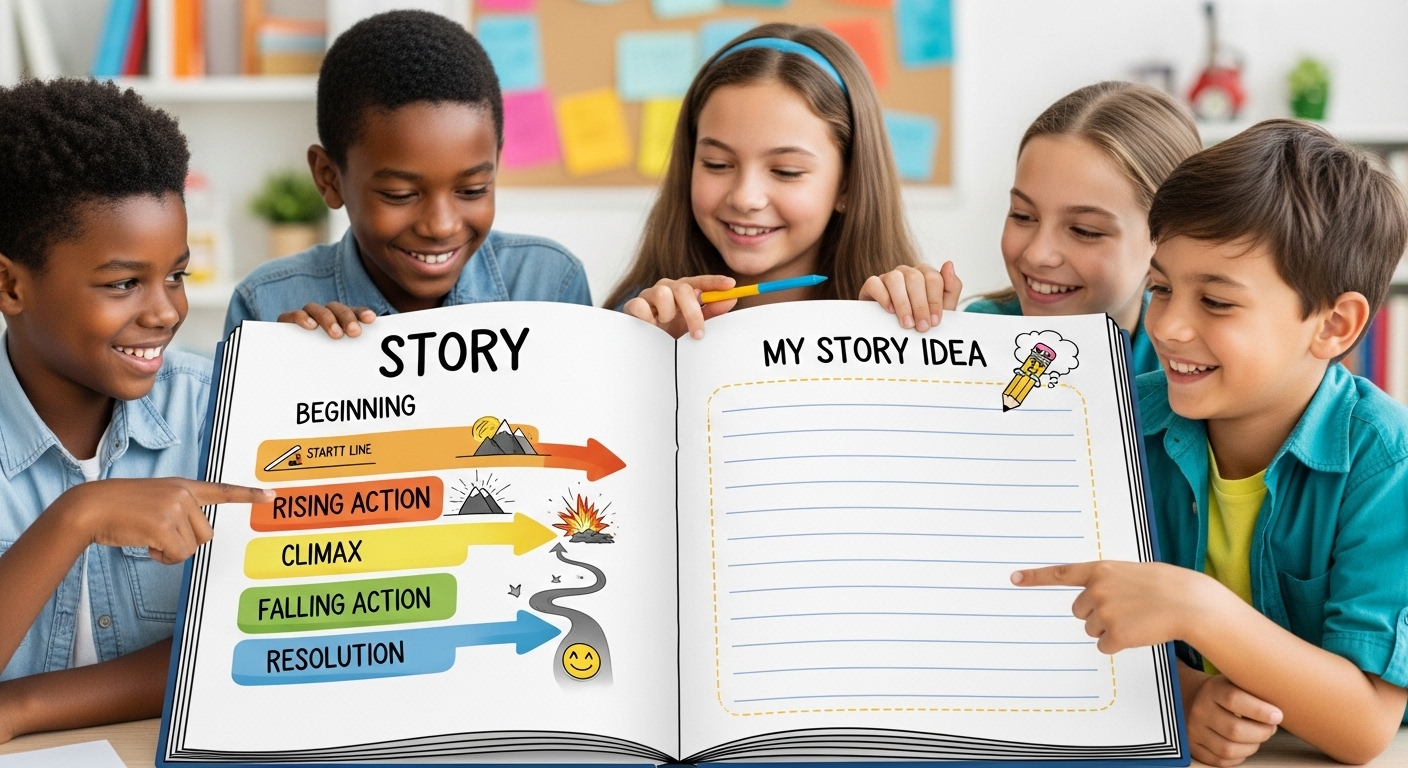
Your plot should be clear and structured in a simple way: Beginning → Middle → End. Start by introducing the character and their world. Then introduce a conflict or goal. After that, show how they attempt to solve it, leading up to a climax or turning point. Finally, offer a satisfying resolution.
Avoid too many subplots or complicated time shifts. Fourth graders can follow a linear plot more easily and enjoy seeing how one event leads to the next. Let each scene build on the previous one. Add suspense by letting the character fail a few times before succeeding. Keep transitions smooth, so students aren’t confused by sudden changes.
This structure is ideal for teaching kids how storytelling works and how they can apply it in their own writing.
5. Using Simple but Effective Language
Clarity is key. When writing for Grade 4, use simple sentence structures but avoid talking down to your readers. Choose vivid verbs and strong nouns over overused adjectives. For example, instead of saying “very big,” say “enormous.”
Use descriptive language to create imagery, but don’t overdo it. Similes and metaphors can be introduced, especially if they’re easy to grasp. Phrases like “as brave as a lion” or “his shoes sounded like rain on a tin roof” can enrich the text without complicating it.
This is also the right time to help young readers explore new vocabulary in context, especially words they’ll want to use in their own stories.
6. Dialogue and Expression
Teaching dialogue through storytelling helps students understand character interaction and emotion. Keep the dialogue short, simple, and realistic. Let the character’s personality shine through what they say.
For example:
“You can’t go in there!” Maya whispered. “It’s haunted!”
Use tags like “said,” “asked,” and occasionally “shouted” or “whispered.” Avoid heavy dialogue tags that might confuse readers. Don’t forget to show the character’s emotions through their actions, too. For instance, “Liam crossed his arms and looked away.” That shows attitude even without words.
When done right, dialogue makes the story feel more alive.
7. Setting the Scene
Setting helps children visualize the story. Whether it’s a schoolyard, a dragon’s cave, or a backyard garden, encourage vivid yet clear descriptions. Start with the senses: What does the place look like? Is it noisy? What smells are in the air?
For example:
“The attic was dark and dusty, with cobwebs hanging from every corner. A faint creaking sound echoed with every step.”
Balance is important—too much detail can lose the reader’s attention. Stick to 2–3 descriptive lines per scene unless the setting is a major part of the plot. Help students learn to paint pictures with their words.
8. Teaching the Editing Process
Fourth-grade students need to be guided through revision. As a writer providing examples, show that editing is a natural part of the process. Begin by checking spelling and punctuation. Then look at sentence flow and clarity.
You can even share an example of a “before” and “after” version of a story paragraph to demonstrate improvement. Encourage students to read their stories aloud—this helps catch awkward phrasing and missing words.
Also, remind them it’s okay to change parts of their story. Revision isn’t a punishment; it’s what makes writing better.
Writing Activities and Practice Prompts (with Examples)
Story prompts are an effective way to get students started. Here are a few you can include in your writing lessons or storybooks:
- “One day, my dog started talking and told me a secret…”
- “I found a map in the school library that led to…”
- “The pencil I borrowed from my friend turned out to be magic…”
Let students build stories around these ideas using a clear structure. As a writer, you can create short model stories using these prompts to demonstrate good story writing techniques.
Common Mistakes to Avoid
When writing for Grade 4, don’t fall into the trap of making stories too complex or overly moralistic. Kids at this level appreciate lessons, but not lectures.
Avoid using adult vocabulary, abstract concepts, or overly long descriptive passages. Also, steer clear of unrealistic dialogue or characters that act too mature.
Stories that are unclear, too fast-paced, or don’t resolve the central conflict can confuse students rather than inspire them.
Final Story Checklist for Grade 4 Writers
Here’s a simple checklist to wrap up the story process:
- ✅ Does the story have a clear beginning, middle, and end?
- ✅ Are the characters interesting and relatable?
- ✅ Is the setting described clearly?
- ✅ Is the vocabulary age-appropriate and expressive?
- ✅ Has the story been edited for spelling and punctuation?
Use this to review your sample story or help students self-edit.
Final Thoughts
Writing stories for Grade 4 is about more than entertainment—it’s about nurturing imagination, emotional awareness, and communication skills. As a writer or educator, you have the power to create stories that inspire, teach, and delight.
By keeping the language accessible, the plots engaging, and the characters relatable, you help children not only enjoy reading but also dream about becoming storytellers themselves. That’s a powerful gift to pass on.


